Blog

  • Post-Holiday Fatigue Recovery: 5 Tips After Chuseok

    Post-Holiday Fatigue Recovery: 5 Tips After Chuseok

    SummaryPost-holiday fatigue recovery tips after Chuseok: why headaches and indigestion happen, and signs it's time to see a doctor for holiday syndrome.

    A long Chuseok (추석) holiday — Korea’s autumn harvest festival — spent with family should leave you feeling refreshed.

    For a lot of people, it does the opposite. Right after the break ends, headaches, stomach trouble, and an odd sense of exhaustion often show up instead.

    Long-distance travel, holiday food prep, and back-to-back family gatherings pile stress onto your body in a short window. In Korea, this cluster of symptoms even has its own name: myeongjeol syndrome (명절증후군), or “holiday syndrome.”

    This guide covers post-holiday fatigue recovery after Chuseok — why headaches and indigestion strike, what causes post-holiday fatigue, and practical ways to bounce back. We’ll also flag the signs that mean it’s time to see a doctor.
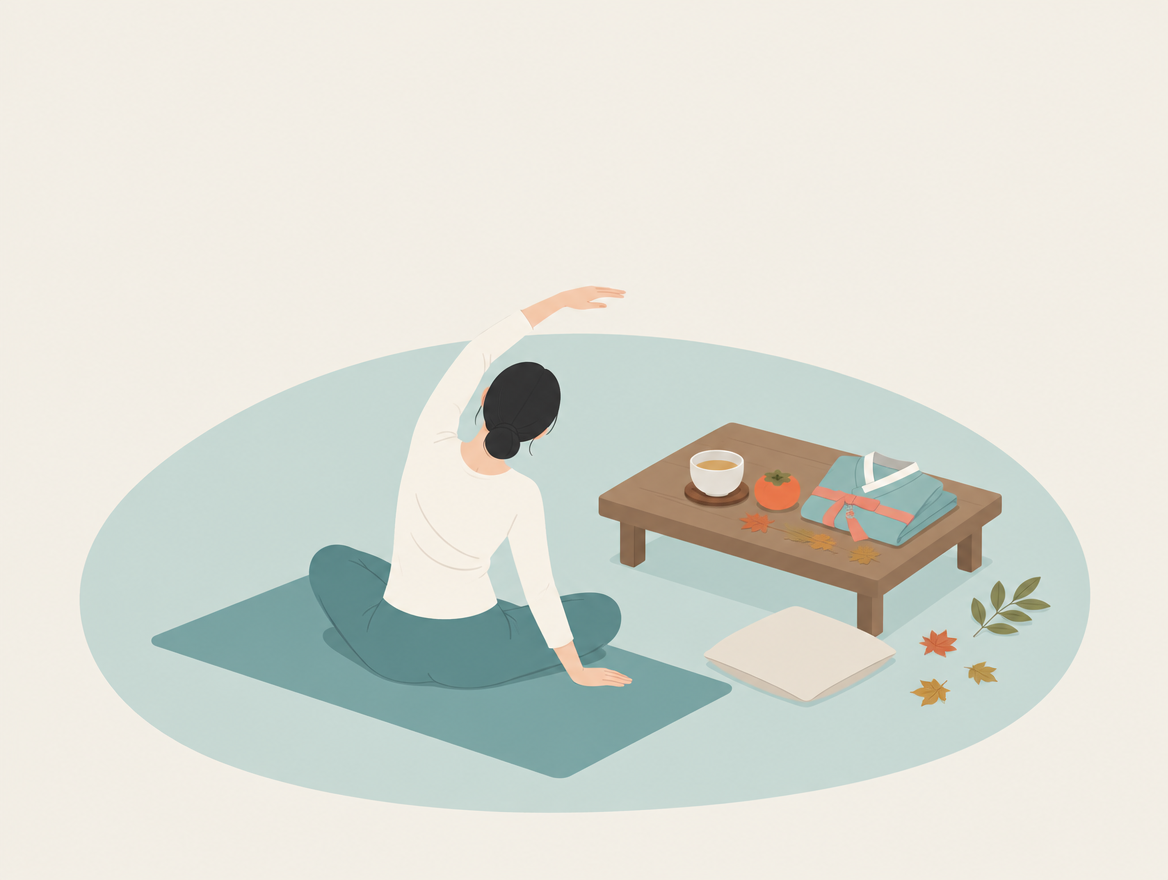
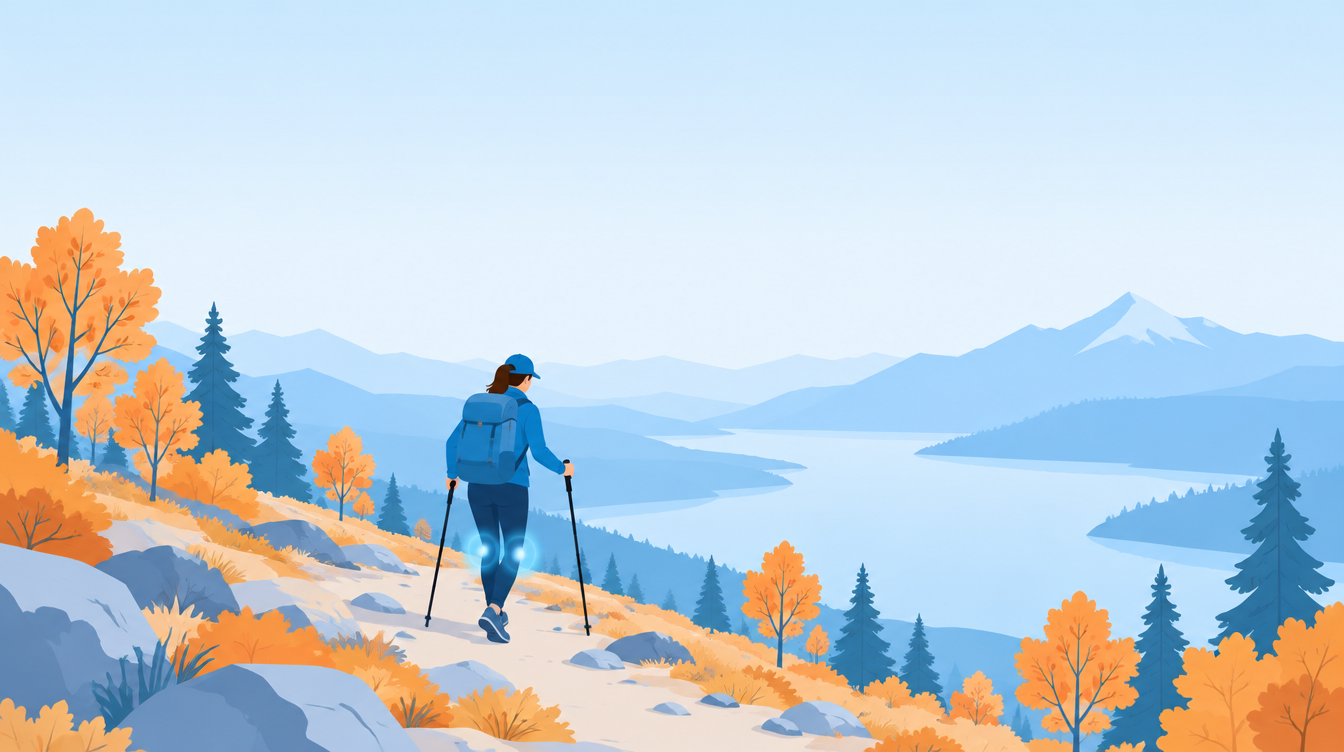
    Person practicing post-holiday fatigue recovery tips after Chuseok

    What Is Holiday Syndrome (Myeongjeol Syndrome)?

    Holiday syndrome is a cluster of physical and mental symptoms — headaches, indigestion, low energy — caused by stress and fatigue building up around a holiday. It isn’t an official diagnosis, but it’s a widely used term in Korea, where extended-family holiday gatherings are a strong tradition.

    Health information from a major Korean hospital describes holiday syndrome as a range of symptoms tied to holiday-related stress, including headaches, indigestion, back pain, muscle aches, and fatigue, along with emotional symptoms like low mood, anxiety, and exhaustion. (Source: Samsung Medical Center health information)

    Category Common Symptoms
    Physical Headache, indigestion, muscle/back pain, body aches, fatigue
    Emotional Low energy, irritability, low mood, anxiety, poor sleep
    Key Point
    Holiday syndrome isn’t a single disease — it’s an umbrella term for symptoms caused by overlapping holiday stress and fatigue. Most people feel better within about a week.

    Why Do Headaches and Indigestion Happen After the Holidays?

    Post-holiday headaches and indigestion usually come from disrupted sleep, travel fatigue, and overeating or drinking all at once.

    Early departures and late nights during the holiday throw off your sleep rhythm. Muscle tension and mild dehydration build up along the way, and that combination often shows up as a headache.

    Holiday meals also tend to be rich — think fried pancakes (jeon), meat, and rice cakes. Eating a lot of these in a short window strains your stomach and can trigger indigestion.

    Ongoing stress is well documented to cause headaches, muscle tension, stomach upset, and fatigue. These symptoms tend to show up more during the holidays, when your routine changes so quickly. (Source: Mayo Clinic)

    Key Point
    Headaches are often driven by muscle tension, poor sleep, and dehydration, while indigestion usually comes from overeating and drinking. Regular meals and enough water may help.

    Why Do I Feel So Exhausted After the Holidays?

    Post-holiday fatigue happens because your body hasn’t caught up yet with a routine that got thrown off during the break.

    When sleep and mealtimes turn irregular for several days, your body’s autonomic balance can slip. Add the physical work of holiday food prep and the emotional toll of extended family time, and that exhaustion can deepen.

    Health authorities in different countries point to the same pattern: ongoing stress can throw off your autonomic nervous system, showing up as fatigue, low energy, and headaches. (Source: Korea Disease Control and Prevention Agency; Japan’s Ministry of Health, Labour and Welfare e-Health Net)

    Caution
    If low energy or low mood lasts more than two weeks, or it’s getting in the way of daily life, don’t just wait it out — see a doctor.

    How Can I Start Post-Holiday Fatigue Recovery?

    The key to post-holiday fatigue recovery is easing your routine back to normal in steps, not all at once.

    Health officials note that post-holiday symptoms typically appear three to four days after the break ends, and most resolve within about two weeks once you adjust your habits. (Source: Yunnan Provincial Health Commission, 2024)

    1. Go to bed 1-2 hours earlier than usual to reset your sleep rhythm
    2. Take a light 20-30 minute walk or stretch each day
    3. Swap rich holiday food for vegetables and whole grains
    4. Drink enough water to support digestion and circulation
    5. Talk through or journal about any family tension instead of bottling it up

    If your symptoms don’t improve with these steps, don’t push through it — check in with a doctor. In Korea, a visit to a local internal medicine clinic is covered under National Health Insurance (NHI, Korea’s public health insurance system), which keeps out-of-pocket costs relatively low. For more on related conditions, browse our Disease Encyclopedia. (Internal link: recommended to replace once a related article is published)

    Checklist
    ✅ Did you go to bed earlier than usual?
    ✅ Did you drink enough water and move a little?
    ✅ Have your symptoms lasted less than two weeks?

    Frequently Asked Questions

    1. How long does holiday syndrome last?
    For most people, symptoms ease up naturally within about a week. If they last more than two weeks or make daily life difficult, it’s worth talking to a doctor.

    2. Is holiday syndrome the same as depression?
    No. Holiday syndrome is a temporary stress response that usually resolves on its own. If low energy or low mood sticks around for a long time, it could point to something like depression, so it’s best to get checked out.

    3. Are there foods that help with recovery?
    Lighter foods — vegetables, whole grains, and fermented foods — tend to be easier on digestion than rich holiday dishes. No single food fixes the symptoms on its own; a balanced diet is what actually helps.

    4. Do I need to see a doctor if symptoms are severe?
    If headaches or indigestion are severe or last more than two weeks, it’s safer to see an internal medicine or family medicine doctor. If exhaustion is severe and comes with low mood, consider talking to a psychiatrist too.

    References

    (Samsung Medical Center), “Holiday Syndrome: The Bitter Side of a Happy Holiday” (원제: 설이 싫어요! 씁쓸한 명절의 단면, 명절증후군). Link
    (Korea Disease Control and Prevention Agency), “Stress” (원제: 스트레스). Link
    (Mayo Clinic), “Stress symptoms: Effects on your body and behavior”. Link
    (Yunnan Provincial Health Commission), “Still Recovering From Post-Holiday Syndrome? Here’s How to Cope” (原题: “节后综合征”还没缓过来?这些方法来缓解), 2024. Link
    (Japan’s Ministry of Health, Labour and Welfare, e-Health Net), “Responding to Physical and Mental Distress” (原題: 心身の不調への対応). Link

    This article is for general informational purposes only and is not a substitute for professional medical advice, diagnosis, or treatment. Please consult a qualified healthcare provider if you have health concerns.
  • Tamiflu Dosage: 3 Key Facts About Oseltamivir Side Effects (2026)

    Tamiflu Dosage: 3 Key Facts About Oseltamivir Side Effects (2026)

    SummaryTamiflu dosage works best within 48 hours of symptoms, twice daily for 5 days. Learn oseltamivir side effects, pediatric dosing, and other flu antivirals.

    Every winter flu season, doctors across Korea write a surge of Tamiflu prescriptions.

    Yet plenty of patients — and worried parents — still aren’t sure about the right Tamiflu dosage, when to start it, or which side effects need a doctor’s attention. In children, one specific side effect deserves real attention.

    The right Tamiflu dosage starts within 48 hours of symptom onset, taken twice daily for 5 days. Adults typically take 75 mg, while children’s doses are based on body weight. Beyond common side effects like nausea, parents should watch for rare behavioral changes in kids and teens, covered below along with other flu antivirals.

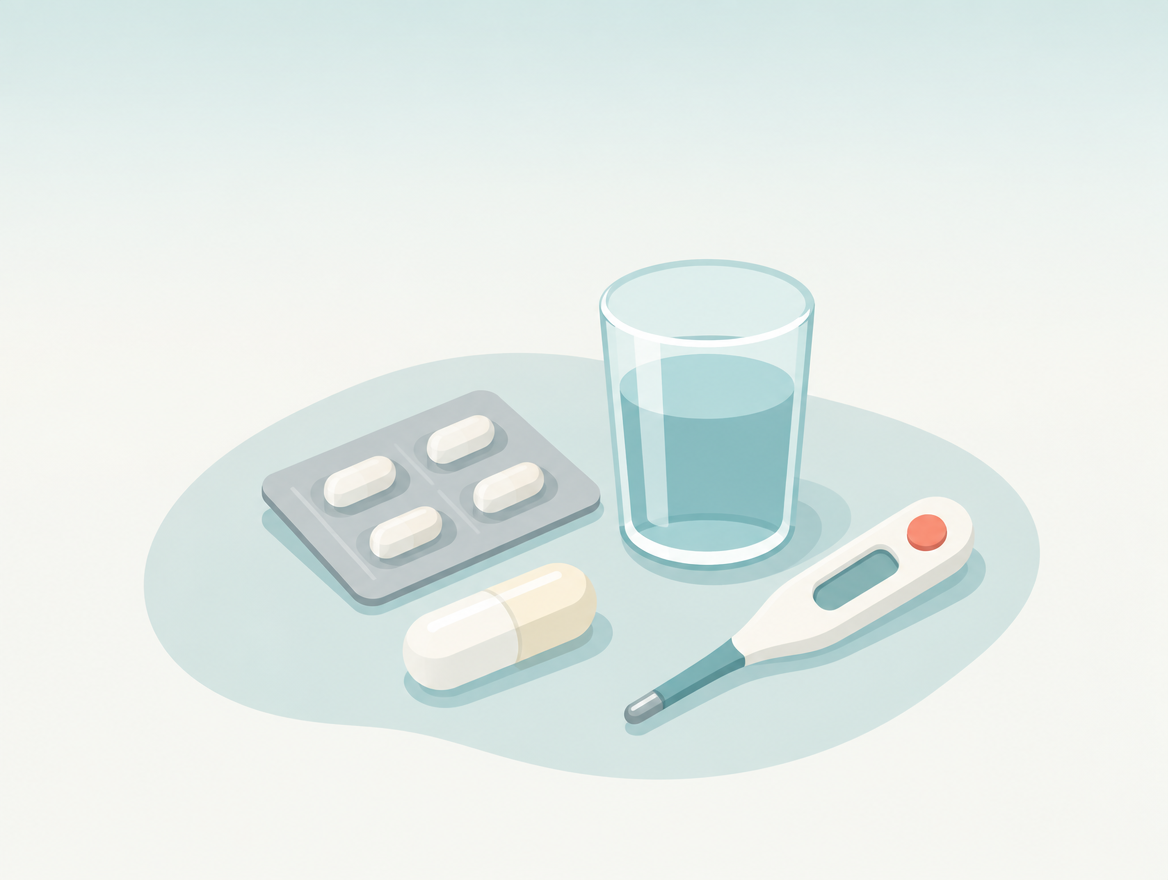
    Illustration explaining Tamiflu dosage and side effects

    What Is Tamiflu (Oseltamivir)?

    Tamiflu is an antiviral medication that fights the flu virus. Its active ingredient is oseltamivir.

    Oseltamivir is an antiviral drug that blocks the influenza virus’s neuraminidase enzyme, stopping the virus from spreading to new cells.

    In Korea, besides Roche’s original Tamiflu, generic versions like Hanmiflu and Fluone are also available. They’re covered under Korea’s National Health Insurance (NHI, the country’s public health insurance system), which keeps out-of-pocket costs low. Oseltamivir works against both influenza A and B, but it only helps if you start it within 48 hours of your first symptom (Source: CDC).

    Key Point
    Tamiflu doesn’t cure the flu — it’s an antiviral that can shorten your symptoms by about a day and lower your risk of complications. Waiting past the 48-hour window significantly reduces how well it works, so see a doctor as soon as flu symptoms hit.

    What’s the Right Tamiflu Dosage?

    Adults take one 75 mg capsule twice a day for 5 days. Kids’ doses depend on their weight.

    Weight Dose (twice daily, 5 days)
    ≤15 kg (33 lb) 30 mg
    15–23 kg (33–51 lb) 45 mg
    23–40 kg (51–88 lb) 60 mg
    Over 40 kg (88 lb) 75 mg

    (Source: CDC)

    Checklist
    ✅ Start within 48 hours of symptoms
    ✅ Take it twice a day, roughly 12 hours apart
    ✅ Finish the full 5-day course even if you feel better
    ✅ Ask about liquid suspension if your child can’t swallow capsules
    ✅ Mention any kidney problems — your dose may need adjusting

    What Side Effects Should You Watch For?

    The most common Tamiflu side effects are nausea and vomiting, but children and teens need extra monitoring for rare behavioral changes.

    Neuropsychiatric events are rare abnormal behaviors — like confusion, hallucinations, or sudden attempts to run or jump — reported in children and teens taking oseltamivir.

    Korea’s Ministry of Food and Drug Safety (MFDS, Korea’s equivalent of the FDA) added a warning to oseltamivir’s label in 2017 after reports of seizures and delirium in pediatric patients. It recommends that caregivers not leave children alone for at least two days after starting the drug (Source: MFDS/Dailypharm). A 2023 U.S. study using Tennessee Medicaid data suggests the flu itself — not necessarily Tamiflu — may be driving some of these symptoms, and research is ongoing (Source: FDA).

    Caution
    Call a doctor right away if your child suddenly tries to run, climb, or jump after taking Tamiflu, or shows confusion or hallucinations. Don’t leave kids and teens unsupervised for the first two days of treatment.
    Key Point
    Common side effects — nausea, vomiting, headache — are usually mild and go away on their own. Stop the medication and call your doctor immediately if you notice a rash or signs of a serious allergic reaction.

    What Other Flu Antivirals Are Available?

    Besides oral oseltamivir, doctors can prescribe inhaled zanamivir, IV peramivir, or single-dose baloxavir.

    Drug Brand Example Route Notes
    Oseltamivir Tamiflu Oral Twice daily, 5 days
    Zanamivir Relenza Inhaled Caution with asthma/COPD
    Peramivir Rapivab IV infusion Single dose
    Baloxavir marboxil Xofluza Oral Single dose

    All four antivirals work best within 48 hours of symptom onset. Your doctor picks the right one based on your age, health conditions, and how easy each option is to take (Source: CDC).

    For more on flu-season medications and supplements, check our Medications & Supplements category.


    Frequently Asked Questions

    1. Can I get a Tamiflu prescription without a positive flu test?
    Yes, doctors can prescribe it based on clinical judgment alone. During flu season, if your symptoms look typical or you’re in a high-risk group, many doctors will prescribe it without waiting for a rapid test.

    2. Can I drink alcohol while taking Tamiflu?
    It’s best to avoid it. Alcohol can worsen nausea and other stomach-related side effects and adds extra strain on your liver during treatment.

    3. What if I forget to take a dose?
    Take it as soon as you remember. If it’s almost time for your next dose, skip the missed one — never double up.

    4. Can Tamiflu be used to prevent the flu, not just treat it?
    Yes. High-risk people closely exposed to someone with the flu can consider preventive dosing within 48 hours of exposure. Dosing differs from treatment, so talk to your doctor first.

    5. How fast will I feel better after starting Tamiflu?
    It varies, but most people see symptoms resolve about a day to a day and a half sooner. Finish the full 5-day course even if you start feeling better early.

    References

    1. (Mayo Clinic), “Oseltamivir (oral route): Side effects and dosage,” 2025 Link

    2. (CDC), “Influenza Antiviral Medications: Summary for Clinicians,” 2025–2026 season Link

    3. (Korea’s Ministry of Food and Drug Safety, via Dailypharm), “Tamiflu Warning: Abnormal Behavior and Fall Risk in Teens” (원제: 타미플루 복용 청소년 추락사…환각 부작용 재조명), 2017 Link

    4. (FDA), “TAMIFLU (oseltamivir phosphate) Prescribing Information,” rev. 2012 Link

    This article is for general informational purposes only and is not a substitute for professional medical advice, diagnosis, or treatment. Please consult a qualified healthcare provider if you have health concerns.
  • Influenza Epidemic Warning: 3 Reasons Behind Korea’s 2026 Alert

    Influenza Epidemic Warning: 3 Reasons Behind Korea’s 2026 Alert

    SummaryInfluenza epidemic warning hit Korea a month early. See 3 reasons for the September flu surge and what the ILI rate data means for you.

    Pediatric waiting rooms are already packed in early September. If you have a school-age child, this might sound familiar. On September 11, 2026, Korea’s health authorities issued the influenza epidemic warning for the 2026-2027 season — more than a month earlier than last year, and the earliest since 2011. Flu usually shows up in late fall. So why is it spreading this fast in late summer?

    This early influenza epidemic warning stems from a mix of a new drifted virus variant, an earlier school term, and lower population immunity after last season’s milder flu activity.

    By early September, the flu-like illness rate had already topped twice the epidemic threshold, rising fastest among elementary school kids.

    Here’s what’s driving the surge, and what you can do about it.

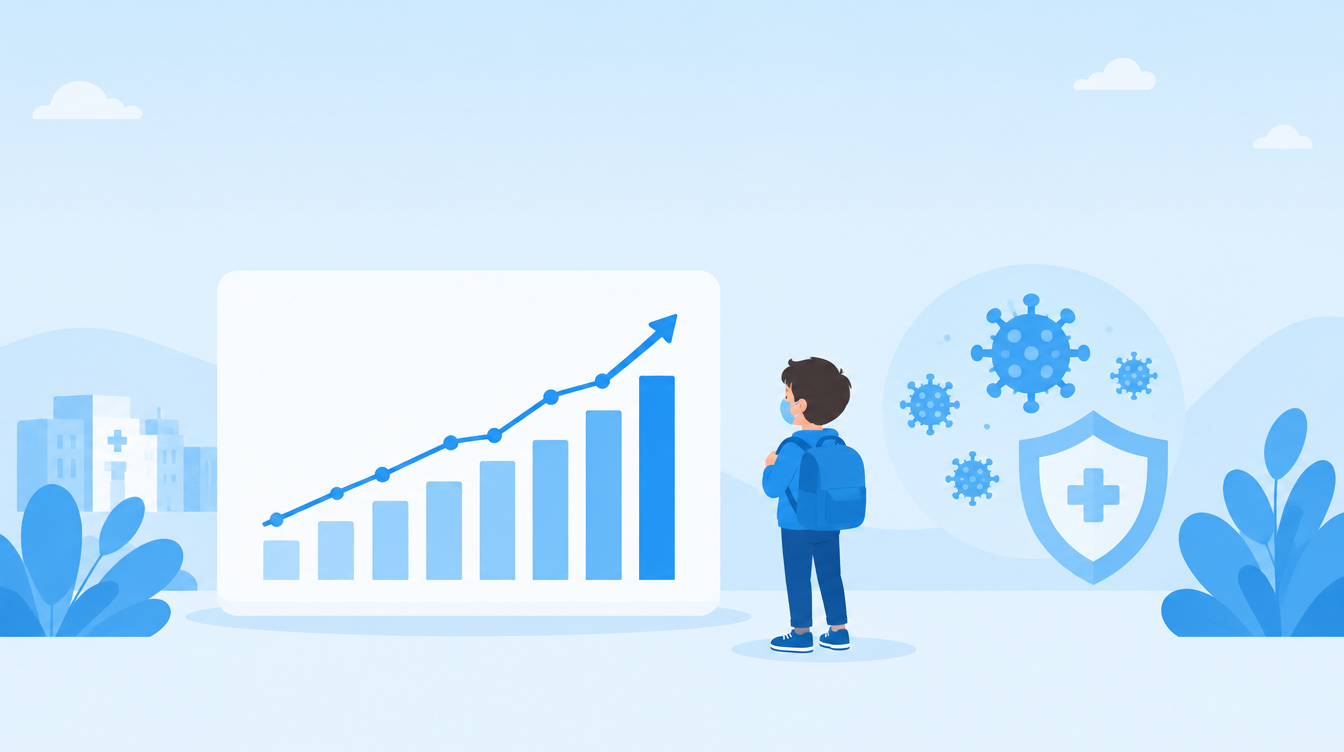
    Chart and masked child illustrating the influenza epidemic warning early 2026

    Why Was Korea’s Influenza Epidemic Warning Issued So Early This Year?

    Korea moved up its flu epidemic warning by more than a month mainly because a fast-spreading new variant collided with an early return to schools and other group settings.

    An influenza epidemic warning is an official alert issued when the flu-like illness rate among outpatients exceeds the season’s epidemic threshold.

    The Korea Disease Control and Prevention Agency (KDCA) declared the alert effective September 11, 2026, at midnight. The previous season’s alert wasn’t issued until October 17, 2025. That makes this year’s call over a month earlier, and the earliest since 2011.

    Key Point
    Korea’s 2026-2027 flu epidemic warning took effect September 11 — over a month earlier than last season, and the earliest since 2011.

    Is a New Virus Variant Behind September’s Flu Surge?

    Yes — a new variant called H3N2 subclade K is one driver of September’s early flu surge, alongside an early school term and waning population immunity.

    H3N2 subclade K is a drifted influenza A strain with enough antibody-binding changes that this season’s vaccine may offer somewhat reduced protection against it.

    Source: According to STAT News (2026), U.S. CDC researchers first flagged subclade K in sequence data in August 2025. Its hemagglutinin protein carries 11 amino acid substitutions compared with this season’s H3N2 vaccine strain, many in regions the immune system uses to recognize the virus.

    It spreads faster, though reported severity is similar to typical seasonal flu.

    Layer on an earlier school start and lower community immunity after last season’s milder wave, and the combination sped up transmission.

    Key Point
    A drifted variant, an early school term, and lower community immunity combined to push flu season ahead of schedule.

    How Sharp Is the Rise in Flu-Like Illness Cases?

    In week 36 (Aug 30–Sept 5, 2026), Korea’s flu-like illness rate hit 25.3 per 1,000 outpatient visits — about twice the epidemic threshold of 12.9, and roughly four times the same week last year (6.6).

    The flu-like illness rate measures the share of outpatients per 1,000 visits showing flu-like symptoms such as fever and cough.

    Week Rate (per 1,000)
    Week 33 7.5
    Week 34 9.2
    Week 35 13.3
    Week 36 (Aug 30–Sep 5) 25.3
    Age group Rate (per 1,000)
    Ages 7-12 (elementary) 75.1
    Ages 1-6 (preschool) 49.8
    Ages 13-18 31.3

    Hospital-based sentinel inpatient counts also nearly doubled week-over-week, from 166 to 300.


    What Changes During an Epidemic Warning — Treatment Costs and Vaccination?

    During the alert period, high-risk groups can get antiviral prescriptions covered by national health insurance without a confirmatory test, and free national vaccination begins on a phased rollout from September 21.

    Children, pregnant women, adults 65 and older, and people with chronic conditions can receive antivirals like oseltamivir based on a doctor’s clinical judgment alone, with the cost covered under 건강보험 (Korea’s national health insurance, a public system that covers most Koreans and many long-term foreign residents).

    Free national flu vaccination for eligible groups starts September 21 and rolls out in phases by age and priority.
    (Internal link: replace once a dedicated article is published) See more respiratory infection articles in the Disease Encyclopedia

    Checklist
    ✅ Cover your mouth and nose with your sleeve when coughing or sneezing
    ✅ Check for fever before school or work, and stay home if you have one
    ✅ Wash your hands often, and consider a mask in crowded indoor spaces
    ✅ If you’re 65+, pregnant, or have a chronic condition, check the vaccination schedule
    Caution
    If you have a high fever, trouble breathing, or an underlying condition, don’t self-medicate. See a doctor or pharmacist right away.

    Frequently Asked Questions

    Q1. When’s the best time to get a flu shot?
    A1. It takes about two weeks to build antibodies, so getting vaccinated as soon as possible around September 21, when national vaccination starts, is a good idea. Ask your clinic about the exact timing for you.

    Q2. How do I tell the flu apart from a common cold?
    A2. Colds tend to build slowly, mostly with a runny nose and sore throat. The flu often hits suddenly with a fever over 38°C, muscle aches, and chills. A test is the safest way to confirm which one you have.

    Q3. Can pregnant women get antivirals without a test too?
    A3. During the alert period, high-risk groups, including pregnant women, can get an antiviral prescription covered by national health insurance based on a doctor’s judgment, without a confirmatory test. Talk with your doctor about whether it’s right for you.

    Q4. Does wearing a mask actually help prevent the flu?
    A4. Influenza spreads mainly through respiratory droplets, so wearing a mask in crowded indoor spaces may help lower your risk of infection. Pairing it with handwashing and good ventilation can boost the effect.

    References

    Edaily (Korea), “Flu Already Spreading — ‘Epidemic Alert’ a Month Earlier Than Last Year” (독감 벌써 유행…지난해보다 한 달 빠른 ‘유행주의보’), 2026. Link
    Ajunews (Korea), “[Breaking] ‘Influenza Epidemic Alert’ Issued — A Month Earlier Than Last Year” (작년보다 한 달 빨라), 2026. Link
    STAT News, “Flu season 2026: Welcome to the winter of subclade K”, 2026. Link
    Mayo Clinic, “Influenza (flu) – Symptoms and causes”, 2026. Link
    China CDC (中国疾病预防控制中心), “National Influenza Surveillance Report, Week 32, 2026”, 2026. Link
    Japan Ministry of Health, Labour and Welfare (厚生労働省), “Press Releases on Influenza”, 2026. Link

    This article is for general informational purposes only and is not a substitute for professional medical advice, diagnosis, or treatment. Please consult a qualified healthcare provider if you have health concerns.
  • Buying Oral Wegovy Online: 3 Warning Signs to Know First

    Buying Oral Wegovy Online: 3 Warning Signs to Know First

    SummaryThinking about buying oral Wegovy online? Learn why it's risky before Korea's approval, how to spot fake pills, and what to do if you've been scammed.

    You’ve probably seen it on Instagram or TikTok: an ad promising “authentic oral Wegovy” for sale online.
    Here’s the catch — that oral pill isn’t even approved for legal sale in South Korea yet.
    The FDA cleared it in the US in December 2025, but Korea’s regulator is still reviewing it.
    That gap has opened the door to a wave of fraudulent ads and fake pills, and buyers need to know the risks.

    Bottom line: buying oral Wegovy online right now is genuinely risky.
    Products sold online before official approval are either mislabeled regular food or unverifiable counterfeits.

    This article covers real enforcement cases, how to check if Wegovy is genuine, and what to do if you’ve been targeted by a diet-drug scam.

    Warning illustration about buying oral Wegovy online

    Is Buying Oral Wegovy Online Legal in Korea?

    No, not legally — not yet, anyway.
    As of September 2026, oral Wegovy still hasn’t received approval from Korea’s Ministry of Food and Drug Safety (MFDS, Korea’s FDA equivalent).

    Oral Wegovy is Novo Nordisk’s pill form of semaglutide, the same active ingredient in the injectable Wegovy, packed into a once-daily tablet instead of a weekly shot.
    The FDA approved it in the US on December 22, 2025, and US sales started in early January 2026 (Source: Novo Nordisk, 2025).

    Korea’s review process is still ongoing, and there’s no confirmed date for local prescriptions.
    So any site selling “authentic oral Wegovy” in Korea right now can’t be sourcing it through a legal channel — full stop.

    Key Point
    The US FDA approved oral Wegovy (25mg semaglutide tablet) in December 2025, but Korea’s approval process is still underway.
    There’s no set date for when it’ll be legally prescribable in Korea.

    Why are online “oral Wegovy” products so risky?

    Because most of them aren’t real medication at all — they’re regular food, or unverified smuggled and counterfeit goods.

    On July 23, 2026, Korea’s MFDS announced it had caught 26 online sellers advertising products under names like “oral Wegovy” and “Olive-shot,” deliberately evoking prescription obesity drugs.
    These sellers marketed ordinary food while blurring out or referencing drug names like GLP-1, Wegovy, and Mounjaro to trick shoppers.

    Together, they sold roughly 600,000 units worth about 11.5 billion Korean won (about $8.3M / 约6000万元 / 約12.1億円).
    In one case, a product costing about 2,000 won (about $1.4 / 约10元 / 約190円) to source was resold for 60,000 won (about $43 / 约310元 / 約5,700円) — a markup of up to 27.5 times (Source: MFDS, 2026).

    It’s not a new pattern, either: in 2024, MFDS flagged 359 cases of illegal online sales of obesity drugs like Wegovy and Saxenda, with GLP-1 drugs making up about 42% of them (Source: MFDS, 2024).

    This is exactly why buying oral Wegovy online from unverified sellers is so dangerous right now.

    Key Point
    July 2026 crackdown: 26 sellers caught, roughly $8.3M in sales, markups up to 27.5x cost.
    Most products weren’t real medication — just regular food with misleading labels.

    How can you tell if Wegovy is genuine?

    The only reliable way is a doctor’s prescription filled at a licensed pharmacy — there’s no shortcut around that.

    Genuine Wegovy means a product that’s been officially approved and dispensed by a licensed pharmacy under a doctor’s prescription.
    The US has already dealt with counterfeit GLP-1 drugs: the FDA warned consumers after fake Ozempic (same drug class) turned up in the legitimate supply chain.

    Those counterfeits had the expiration date and lot number printed in the wrong spot on the label, and the needles couldn’t be verified as sterile, raising infection risk (Source: FDA, 2024).
    Since oral Wegovy isn’t even officially approved in Korea yet, any online listing claiming “guaranteed authentic” or “genuine overseas import” should raise a red flag on its own.

    Checklist
    ✅ Is it sold without requiring a prescription?
    ✅ Is it sold through social media or messaging apps instead of a pharmacy?
    ✅ Is the price suspiciously low compared to market rate?
    ✅ Can the seller not show official import/customs documents?
    ✅ Do they claim “verified authentic” with no way to actually check?
    — If any of these apply, don’t buy it.
    Caution
    If you have a bad reaction to a drug or supplement bought online, you likely won’t be eligible for consumer protection remedies.
    Buy medication only through a hospital or licensed pharmacy.

    What should you do if you’re a victim of diet-drug false advertising?

    Stop using the product immediately and report it to Korea’s MFDS illegal-distribution reporting center.
    If you already tried buying oral Wegovy online and got scammed, here’s what to do next.

    MFDS accepts tips about false advertising and illegal sales through its online reporting page (mfds.go.kr).
    Save screenshots of the ad and your payment records — they help investigators build a case.

    If you’ve had a reaction, see a doctor first, then you can also file a complaint with the Korea Consumer Agency at hotline 1372 (a government-run hotline for consumer disputes in Korea).
    (Internal link: recommend replacing with a dedicated article once published) You can find more medication safety information in our Medications & Supplements category.

    Caution
    If you already paid, file a dispute (chargeback) with your card issuer right away.
    Bank transfers are much harder to refund, so check your payment method before you buy anything else online.

    Frequently Asked Questions

    1. Can I get a prescription for oral Wegovy in Korea?
    Not as of September 2026 — it hasn’t been approved yet. Check with your doctor once approval is finalized.

    2. Is it safe to buy oral Wegovy through overseas direct shipping?
    No. Customs can’t verify the ingredients or quality, and you’ll have little recourse if something goes wrong.

    3. Is oral Wegovy the same drug as injectable Wegovy?
    Same active ingredient (semaglutide), but different form, dosage, and approval status. Only the injectable version is officially approved in Korea right now.

    4. What if I’ve already bought and started taking a diet drug online?
    Stop taking it immediately and see a doctor nearby. Hold onto the product and your payment records in case you need to report it.

    References

    (Ministry of Food and Drug Safety, Korea), “26 Online Sellers Caught for False Advertising of Diet Products as ‘Oral Wegovy’” (먹는 위고비 등 다이어트 식품 부당광고 26개소 적발), 2026. Link
    (Ministry of Food and Drug Safety, Korea), “359 Cases of Illegal Online Sales of Obesity Drugs Like Wegovy Caught” (위고비 등 비만치료제 온라인 불법판매 359건 적발), 2024. Link
    (U.S. Food and Drug Administration), “FDA warns consumers not to use counterfeit Ozempic (semaglutide) found in U.S. drug supply chain”, 2024. Link
    (Novo Nordisk), “FDA approves Novo Nordisk’s Wegovy® pill, the first and only oral GLP-1 for weight loss in adults”, 2025. Link

    This article is for general informational purposes only and is not a substitute for professional medical advice, diagnosis, or treatment. Please consult a qualified healthcare provider if you have health concerns.
  • Seasonal Hair Loss in Fall: 5 Causes and How Long It Lasts

    Seasonal Hair Loss in Fall: 5 Causes and How Long It Lasts

    SummarySeasonal hair loss in fall explained: 5 causes, how long it lasts, when to see a dermatologist, and simple ways to manage shedding based on research.

    Notice more hair on your pillow or hairbrush every fall? You’re not imagining it.

    Research consistently shows that hair shedding follows a seasonal pattern, peaking in late summer and early fall. Understanding seasonal hair loss in fall helps you tell normal shedding apart from something that needs a dermatologist’s attention.

    This article covers why seasonal hair loss in fall happens, how long it lasts, how to tell it apart from conditions needing treatment, and practical ways to manage it — based on published research and Korean health data.

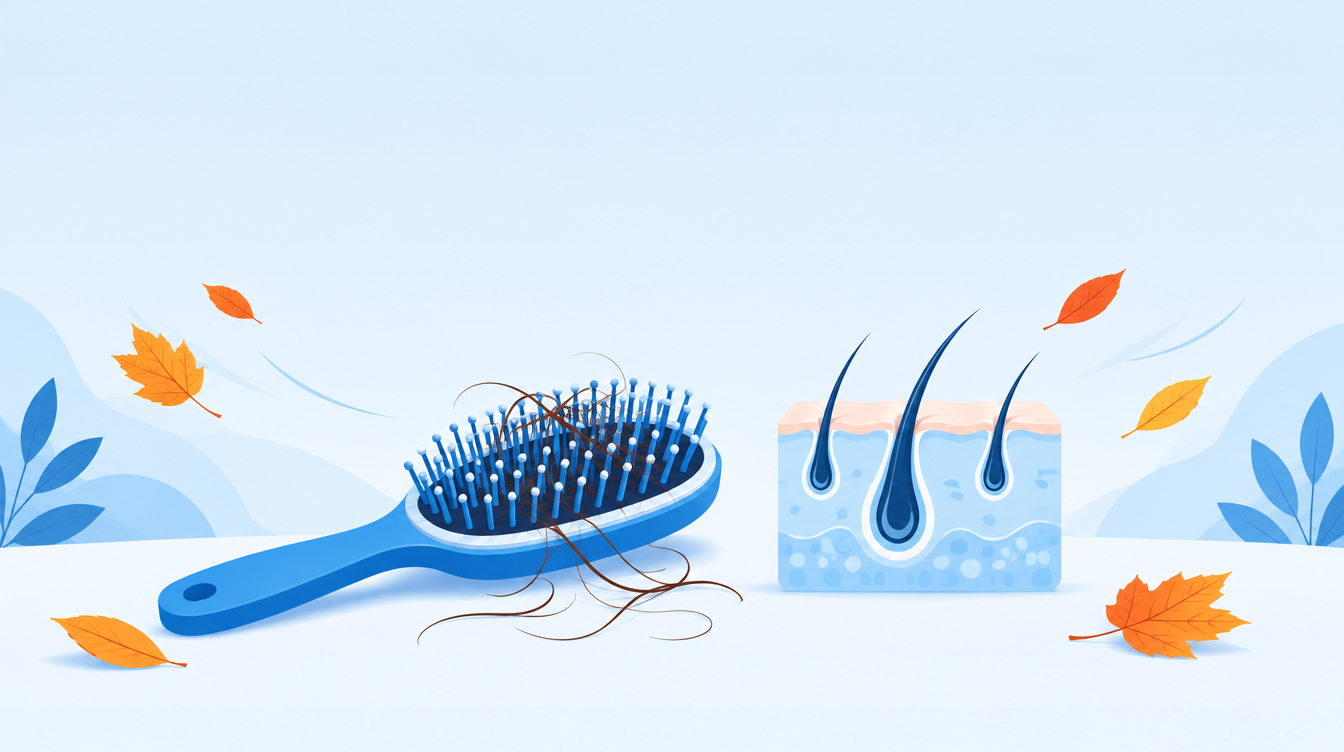
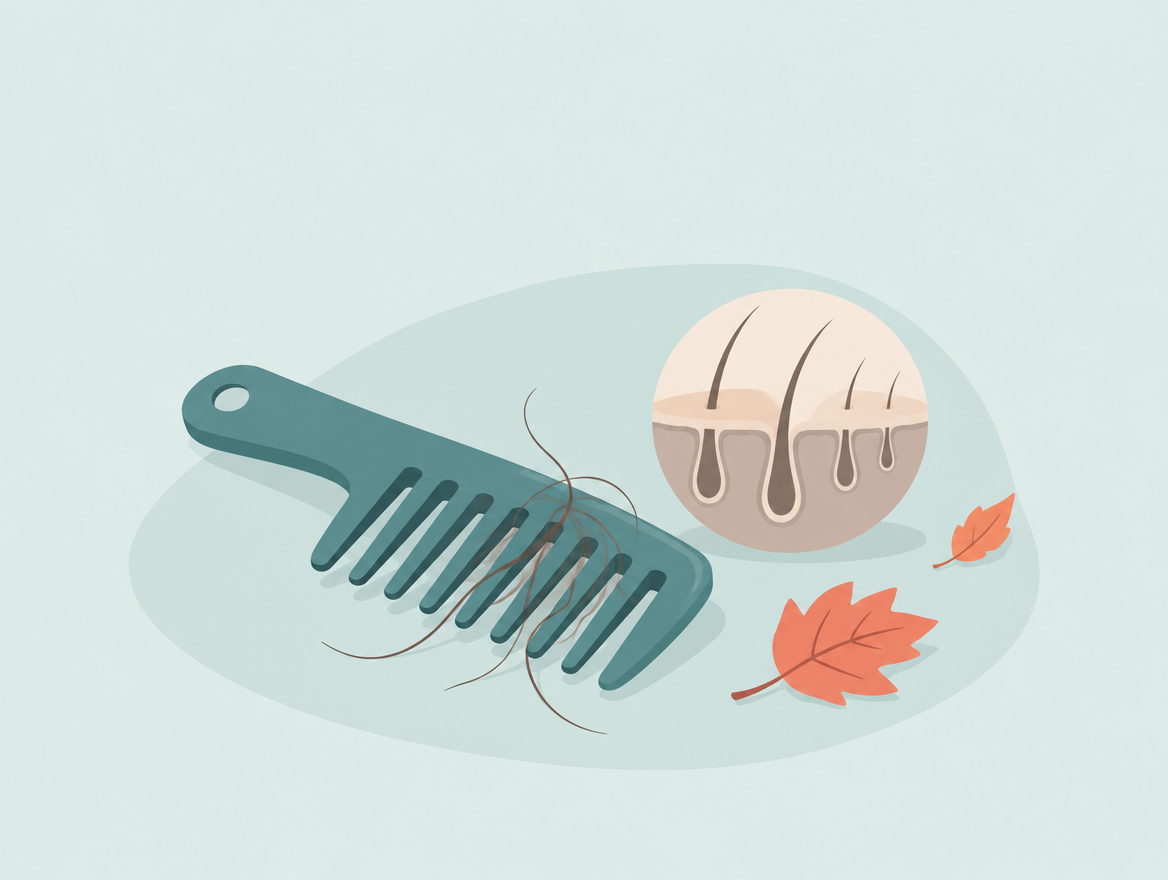
    seasonal hair loss in fall shown as strands of hair caught in a hairbrush

    Why does hair loss get worse in fall?

    It’s the combined effect of summer UV damage to hair follicles and a hormonal shift triggered by shorter daylight hours, which pushes many hairs into their resting phase at once.

    Telogen effluvium is a condition where a large number of hair follicles shift into the resting (telogen) phase at the same time, causing noticeable shedding weeks later.

    According to published research, late summer through early fall (August–October) is when the proportion of resting-phase hair is highest during the year. Fall hair loss usually isn’t caused by a single factor — several combine at once.

    Key Point
    Fall hair loss results from a combination of summer UV damage, hormonal shifts from reduced daylight, dry scalp conditions, and nutritional imbalance.
    Cause Explanation
    Less daylight Shorter days shift hormone rhythms, pushing growth-phase hairs into rest.
    Summer UV damage Sun, sweat, and oil buildup from summer weaken follicles by fall.
    Dry scalp Drier air and big temperature swings disrupt the scalp’s moisture balance.
    Nutrition and stress Low protein, iron, zinc, or vitamins, plus stress, can affect the hair cycle.

    Source: International Journal of Trichology, “Comment on Seasonal Hair Shedding,” 2024


    How long does fall hair loss last?

    Most seasonal hair loss settles on its own within three to six months, without treatment.

    Clinical sources note that losing 50 to 100 hairs a day is normal, and seasonal shedding tends to peak around September.

    Research reviews confirm that acute telogen effluvium typically stops three to six months after the triggering factor goes away. The increase is temporary — overall hair density usually doesn’t drop noticeably.

    Key Point
    Fall hair loss typically peaks around September and resolves on its own within three to six months once the trigger fades.

    Source: National Library of Medicine (NIH, PMC), “Telogen Effluvium: A Review of the Literature,” 2020


    How can you tell normal shedding from hair loss that needs a doctor?

    Even shedding under 100 hairs a day that fades within a few months is usually normal. Patchy thinning or heavy shedding lasting over six months needs medical evaluation.

    Normal seasonal hair loss is temporary shedding that recovers on its own without treatment. Genetic conditions like androgenetic (male or female pattern) alopecia and alopecia areata, however, progress regardless of season and need separate diagnosis and care.

    Caution
    See a dermatologist if you notice:
    · Shedding over 100 hairs a day for more than six months
    · Round bald patches or visible scalp thinning
    · Severe itching, redness, or flaking on the scalp
    · A family history combined with a receding hairline or crown

    Source: Cleveland Clinic, “Telogen Effluvium: Symptoms, Causes, Treatment & Regrowth,” 2024


    What are the best ways to manage seasonal hair loss in fall?

    Scalp hydration, balanced nutrition, sun protection, and stress management form the basics of managing seasonal hair loss in fall.

    Managing seasonal hair loss is not about stopping shedding entirely — it’s about keeping your scalp environment healthy so follicles can move smoothly into their next growth phase.

    Checklist
    ✅ Use a gentle shampoo and rinse thoroughly
    ✅ Apply scalp moisturizer or oil to fight dryness
    ✅ Eat enough protein, zinc, iron, B vitamins, and vitamin D
    ✅ Wear a hat or use an umbrella to protect your scalp from UV
    ✅ Get enough sleep and manage stress to keep hormones balanced

    If shedding doesn’t noticeably improve with these habits, an accurate diagnosis from a dermatologist matters more than self-care alone. (Internal link: recommend replacing with a related article once published)


    Frequently Asked Questions

    1. Does fall hair loss happen to women too?
    Yes. Among roughly 248,000 patients treated for hair loss in Korea in 2022, per Health Insurance Review & Assessment Service (HIRA — Korea’s national health claims review agency) data, 110,469 were women, close to the 137,446 men. Seasonal hair loss can affect anyone regardless of gender.

    2. Which nutrients can help with fall hair loss?
    Protein, zinc, iron, B vitamins, and vitamin D may support follicle health. No single supplement can be said to cure hair loss, though — a balanced diet should come first.

    3. Can stress make fall hair loss worse?
    Chronic stress is a known factor that can push hair from the growth phase into the resting phase. Combined with seasonal changes, it may make shedding feel more noticeable.

    4. Does alopecia areata also get worse in fall?
    Alopecia areata is an autoimmune condition with a different mechanism than seasonal telogen effluvium. Season isn’t a direct cause, though stress may influence symptoms — see a dermatologist if you suspect alopecia areata.

    References

    Health Insurance Review & Assessment Service (HIRA, 건강보험심사평가원), “Statistics on Hair Loss Patient Treatment,” 2023. Link
    Cleveland Clinic, “Telogen Effluvium: Symptoms, Causes, Treatment & Regrowth,” 2024. Link
    National Library of Medicine (NIH, PMC), “Telogen Effluvium: A Review of the Literature,” 2020. Link
    International Journal of Trichology, “Comment on Seasonal Hair Shedding,” 2024. Link

    This article is for general informational purposes only and is not a substitute for professional medical advice, diagnosis, or treatment. Please consult a qualified healthcare provider if you have health concerns.
  • Cervical Cancer Screening Age Korea: 2026 Guide to Expanded Eligibility

    Cervical Cancer Screening Age Korea: 2026 Guide to Expanded Eligibility

    SummaryCervical cancer screening age Korea has expanded to 20+. See who qualifies in 2026, screening intervals, and free options for women in their 20s.

    Cervical cancer incidence among women aged 15 to 34 in Korea has reached 5 per 100,000, ranking fourth after thyroid, breast, and colorectal cancer.

    Many women in their 20s still assume cervical cancer screening is “for older women.”

    But the cervical cancer screening age Korea has set already starts at 20 and up, and knowing exactly who qualifies can make a real difference in early detection.

    This article walks through how the cervical cancer screening age Korea has expanded, who qualifies in 2026, the screening interval, free screening for women in their 20s, and how the program may change going forward.

    Korea’s national program covers Pap smear screening from age 20 onward.

    Cervical cancer screening age expansion in Korea infographic

    Cervical Cancer Screening Age Korea: How Has It Expanded?

    Any woman aged 20 or older qualifies for Korea’s national cervical cancer screening.
    National cervical cancer screening in Korea is a free Pap smear-based program offered every two years to women aged 20 and up.

    The starting age used to be 30, but it was lowered to 20 in 2016, expanding the screening age significantly.
    The National Health Insurance Service (NHIS, Korea’s public health insurance corporation) covers the full cost for insured members, their dependents, and Medical Aid beneficiaries (Korea’s coverage for low-income residents).

    Key Point
    · Eligible age: women 20 and older
    · Cost: fully covered by NHIS (free)
    · Test used: Pap smear (cervical cytology)

    Source: National Health Insurance Service (NHIS), “Prevent Cervical Cancer Early,” 2022.


    How Often Should You Get a Cervical Cancer Screening in Korea?

    If your last result was normal, once every two years is enough.
    The screening interval is a two-year cycle: you’re called up in the year that matches your birth year’s odd/even parity.

    In 2026 (an even year), women born in even years are eligible; in 2025, women born in odd years were.
    If a past result showed abnormal cells or a positive HPV test, your doctor may shorten the interval to one year or even six months, so always check the follow-up date on your result.

    Checklist: Are you eligible in 2026?
    ✅ Are you 20 or older?
    ✅ Were you born in an even year (for 2026)?
    ✅ Are you an NHIS member, dependent, or Medical Aid beneficiary?
    ✅ Have you checked your status on the NHIS app (The건강보험)?

    Source: National Health Insurance Service (NHIS), National Cancer Information Center.


    Is Free Cervical Cancer Screening Available for Women in Their 20s?

    Yes. Women in their 20s (20 and older) are fully covered under the national program.
    Even so, screening rates among women in their 20s tend to lag behind older age groups.

    Work schedules and reluctance to visit a gynecologist are common reasons, along with the misconception that no symptoms means no risk.
    Given that cervical cancer already ranks 4th in incidence among women aged 15-34, this isn’t an age group that can afford to skip screening.
    Since earlier HPV exposure raises risk, screening eligibility applies at 20 and up regardless of sexual history — worth remembering if you’ve been putting it off.

    Caution
    Screening matters even without symptoms. Talk to a gynecologist about whether screening makes sense for your individual situation.

    Source: MedWorld News, “Cervical Cancer Ranks 4th in Incidence Among Women Aged 15-34,” March 5, 2025.


    Will Korea’s National Cervical Cancer Screening Expand Further?

    There’s active discussion about adding or shifting to HPV DNA testing alongside the current Pap smear-based program.
    The WHO recommended HPV DNA testing as the primary screening method in 2021, and countries like Australia, EU member states, and the US have already adopted or expanded it.

    Korea’s current Pap smear has a sensitivity of roughly 50-70%, compared to over 96% for HPV DNA testing — a gap medical societies in Korea have repeatedly cited when calling for the program to be updated.
    Cervical cancer cases in Korea rose from 61,636 in 2020 to 70,598 in 2024, about 15%, while HPV infection cases jumped 32.8%, from 10,945 to 14,534, over the same period.
    The WHO’s 90-70-90 elimination strategy — 90% of girls vaccinated by 15, 70% of women screened with a high-performance test by 35 and again by 45, and 90% of detected cases treated by 2030 — could shape how Korea’s own program evolves.

    For related exam and procedure guides, see the category page. Exams & Procedures Guide (Internal link: to be replaced with a related article once published)

    Source: Doctors News (의협신문), “Low Sensitivity in National Cervical Cancer Screening Sparks Calls for HPV DNA Testing” (자궁경부암 국가검진 민감도 낮아 “HPV DNA 검사 도입해야”), Sept. 19, 2025 / WHO, “Cervical Cancer” Fact Sheet.


    Frequently Asked Questions

    1. Is Korea’s national cervical cancer screening really free?
    Yes. If you’re 20 or older and it’s your eligible year, the NHIS covers the full cost.

    2. Am I eligible for screening in 2026?
    2026 is an even year, so women born in even years are eligible. Check your exact status on the NHIS website or app.

    3. Do I need screening even without sexual experience?
    Eligibility applies to all women 20 and older regardless of sexual history. Talk with a gynecologist about your individual situation.

    4. What happens if my results show something abnormal?
    Your follow-up interval is usually shortened to one year or six months, and further testing (including HPV testing) may be recommended. Follow the guidance on your results notice.

    5. If I got the HPV vaccine, can I skip screening?
    No. The HPV vaccine doesn’t cover every high-risk strain, so regular screening is still recommended regardless of vaccination status.


    References

    1. National Health Insurance Service (NHIS), “Prevent Cervical Cancer Early,” 2022. Link
    2. National Cancer Information Center (National Cancer Center Korea), “Cervical Cancer.” Link
    3. Doctors News (의협신문), “Low Sensitivity in National Cervical Cancer Screening Sparks Calls for HPV DNA Testing,” Sept. 19, 2025. Link
    4. MedWorld News, “Cervical Cancer Ranks 4th in Incidence Among Women Aged 15-34,” March 5, 2025. Link
    5. WHO, “Cervical Cancer” Fact Sheet, 2025. Link
    6. Mayo Clinic News Network, “Mayo Clinic Q and A: Cervical Cancer and HPV Screening.” Link

    This article is for general informational purposes only and is not a substitute for professional medical advice, diagnosis, or treatment. Please consult a qualified healthcare provider if you have health concerns.
  • Hiking Knee Pain Prevention: 5 Tips for Safe Autumn Trails

    Hiking Knee Pain Prevention: 5 Tips for Safe Autumn Trails

    SummaryHiking knee pain prevention tips for autumn trails: why downhill hiking hurts your knees, proper pole technique, and first aid for trail falls.

    Fall foliage season packs Korea’s trails shoulder to shoulder.

    Everyone worries about the uphill huffing and puffing, but most knee injuries actually happen on the way down. One distracted step while admiring the colors, and your knees are already absorbing several times their usual load.

    This guide covers hiking knee pain prevention for autumn trails: why descents hurt your knees, how to use trekking poles correctly, practical prevention habits, and first aid if you take a fall.

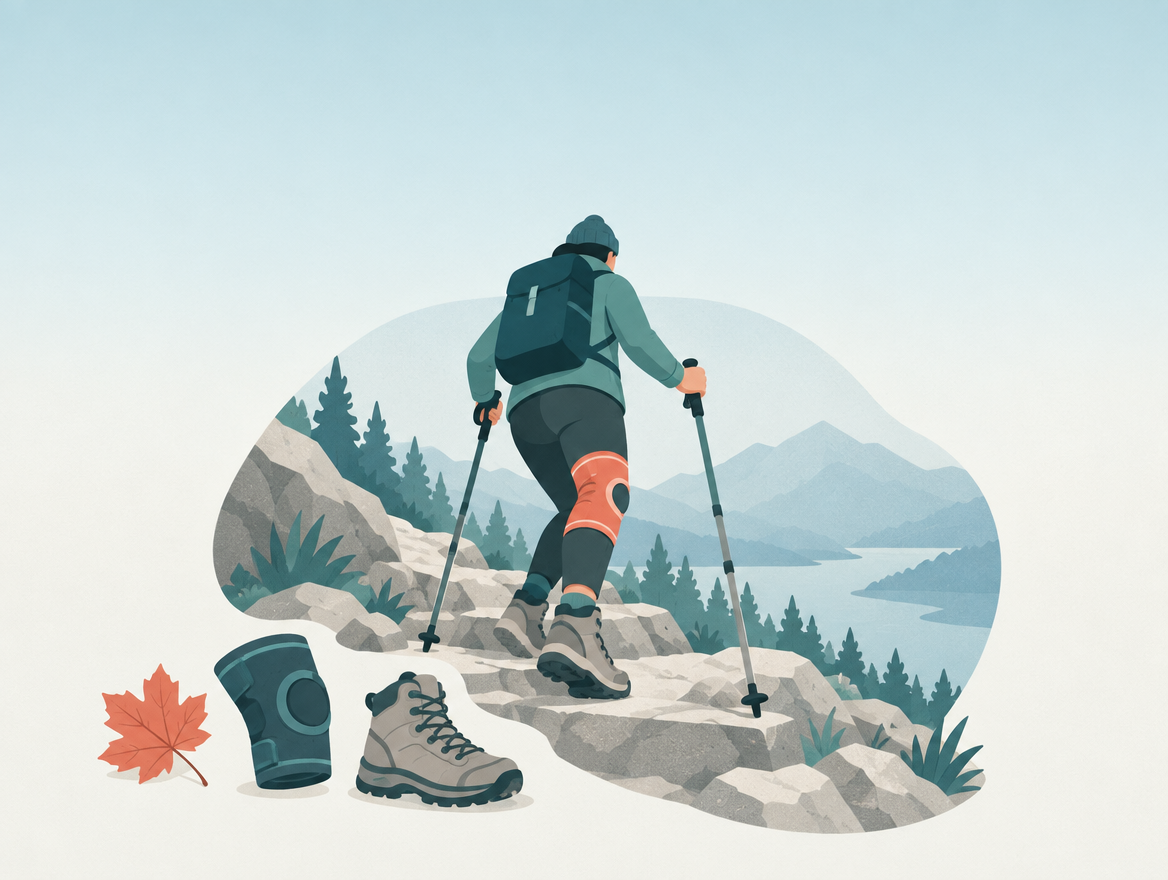
    Hiker using trekking poles to prevent knee pain while descending an autumn trail

    Why do your knees hurt more on the way down?

    Because descending puts 3 to 5 times more impact on your knees than walking on flat ground.

    For someone weighing 70kg, each downhill step can send roughly 200 to 350kg of force through the knee joint. That load concentrates where your kneecap meets your thighbone, and that’s where the pain starts.

    Patellofemoral pain syndrome is a condition where the kneecap tracks off its normal path over the thighbone, causing friction and irritation in the surrounding tissue.

    If you feel a nagging ache behind your kneecap on stairs or downhill sections, or a sharp twinge when you squat, this syndrome could be the cause. It shows up more easily in older hikers with osteoarthritis or weaker muscles around the knee.

    Key Point
    Downhill impact on your knees is 3-5x that of flat ground. At 70kg, that’s roughly 200-350kg of force per step.
    Source: The Wells Nowon clinic blog

    Do trekking poles really protect your knees?

    Yes. Leaning on poles can cut the load on your knees by more than half.

    Shifting about 34% of your body weight onto poles can drop knee load to less than half and hip load to around 0.6 times your body weight, according to Korean orthopedic reporting. Using both poles together is also linked to roughly a 20% reduction in load on your knees and spine.

    Trekking poles are gear that shifts weight from your knees to your arms on descents, easing the load on your joints. They only work well if you adjust the length for the terrain.

    Terrain Pole Length
    Uphill Slightly shorter than a 90° elbow bend
    Flat 90° elbow angle
    Downhill 5-10cm longer than the flat setting
    Checklist
    ✅ Plant both poles together on descents and lean into them
    ✅ Lengthen poles 5-10cm for downhill sections
    ✅ Zigzag down the trail and never lock your knees straight

    Hiking Knee Pain Prevention: How Can You Avoid Knee Injuries on Autumn Hikes?

    Warm up before you descend, use poles, manage your pack weight, and strengthen the muscles around your knees.

    Hiking knee pain prevention starts before you even hit the trail. Spend at least 10 minutes stretching your knees and ankles beforehand. Keep your pack under 10-15% of your body weight.

    Regular squats and stair climbing to build your quads and glutes can help absorb the downhill impact. You can find more on knee joint conditions in our Disease Encyclopedia category. (Internal link: to be replaced with a related article once published)

    Key Point
    1. Stretch knees and ankles for 10 minutes before you start
    2. Keep your pack under 10-15% of body weight
    3. Zigzag downhill with shorter strides
    4. Choose boots with solid ankle support
    5. Pace yourself with short breaks every 30 minutes
    Caution
    If you have osteoarthritis, carry extra weight, or have injured your knee before, take extra care on descents. A knee brace can help, but if you already have symptoms, talk to an orthopedic doctor before you hike.

    What should you do if you fall on the trail?

    Don’t push through it — follow the RICE method for initial care.

    RICE stands for Rest, Ice, Compression, and Elevation, four steps commonly used as first aid for acute injuries.

    1. Rest: Stop moving right away and keep weight off the injured area.
    2. Ice: Wrap ice or a cold water bottle in a cloth and apply for 20 minutes at a time to help with swelling.
    3. Compression: Wrap the area snugly with a bandage to limit further swelling.
    4. Elevation: Raise the injured leg above heart level if you can.
    Caution
    If you can’t put any weight on the leg, the knee looks swollen or deformed, or it’s hot and red, stop descending, call for rescue, and get medical care right away. Contact the national park safety center or emergency services immediately.

    If pain lingers, see an orthopedic doctor rather than waiting it out. National Health Insurance (Korea’s public health insurance system, which covers most residents) covers a large share of outpatient and ER costs for foreign residents enrolled in the system too.


    Frequently Asked Questions

    1. Do I need trekking poles going uphill too?
    Yes, poles help with balance and push-off going uphill. But their knee-protecting benefit is far bigger on the way down.

    2. Can a knee brace fully prevent hiking injuries?
    No. A brace can support the joint and reduce perceived load, but it won’t fully prevent injury on its own. Pair it with strength training and proper technique.

    3. My knee’s still swollen three days after a hike — what now?
    If self-care hasn’t helped and swelling or pain lasts more than three days, see an orthopedic doctor for a proper diagnosis. Ligament or meniscus damage can’t be ruled out.

    4. Can I still hike in fall if I have osteoarthritis?
    It depends on how severe your symptoms are, so check with your doctor before you go. Choosing a gentle route and using poles with a knee brace together can help.


    References

    Ministry of the Interior and Safety via Korea.kr, “October Sees the Most Hiking Accidents of the Year” (원제: 10월 연중 등산사고 가장 많아…) Link
    The Kyunghyang Shinmun, “9,172 Hiking Accidents a Year, 2,509 Injured” (원제: ‘등산사고’ 한 해 9170여건 발생·2500여명 피해), 2026 Link
    Hidoc Expert Column, “What Is the RICE Method for Injury First Aid?” (원제: 부상 후 초기 대처 ‘RICE 요법’이란?) Link
    Seoul Economic Daily, “Trekking Poles Cut Spine and Knee Surgery Rates in Half” (원제: 등산스틱 쓰면 척추·무릎 수술 절반 줄어요) Link
    Mayo Clinic, “Sprain: First aid” Link

    This article is for general informational purposes only and is not a substitute for professional medical advice, diagnosis, or treatment. Please consult a qualified healthcare provider if you have health concerns.
  • Free Pneumococcal Vaccine Korea: Who Qualifies at 65 in 2026

    Free Pneumococcal Vaccine Korea: Who Qualifies at 65 in 2026

    SummaryLearn who qualifies for the free pneumococcal vaccine Korea offers seniors at 65, how to apply, and possible side effects — updated for 2026 eligibility rules.

    Every autumn, health centers and neighborhood clinics across Korea post notices about the free pneumococcal vaccine Korea offers to seniors 65 and older.

    Yet many people still aren’t sure who actually qualifies or how to sign up. Turning 65 doesn’t trigger an automatic appointment, and there’s no online form to submit.

    This article walks you through exactly who’s eligible for the free pneumococcal vaccine at 65 in Korea, how to get it, and what side effects to watch for.

    In short, the free pneumococcal vaccine Korea offers goes to anyone registered as 65 or older who has never received the PPSV23 pneumococcal vaccine — one free dose per person.

    No advance application is needed — just bring an ID to a designated clinic, hospital, or public health center.

    Free pneumococcal vaccine eligibility for adults 65 and older in Korea

    Who Qualifies for the Free Pneumococcal Vaccine Korea Offers at 65?

    You qualify if you’re registered as 65 or older by birth date and have never received the PPSV23 vaccine.

    This is the free pneumococcal vaccine Korea provides through a government initiative that fully covers one dose of the 23-valent pneumococcal polysaccharide vaccine (PPSV23) for adults 65 and older, aimed at preventing invasive pneumococcal disease.

    As of 2026, that means anyone born on or before December 31, 1961 (Source: Korea Disease Control and Prevention Agency, KDCA). If you already received PPSV23 after turning 65, you’re no longer eligible for the free program.

    Registered foreign residents 65 or older enrolled in Korea’s National Health Insurance (건강보험, the country’s public health insurance system covering most residents, distinct from a private indemnity plan) are generally included too, since the program runs on public health funding rather than private insurers.

    Key Point
    This free pneumococcal vaccine Korea benefit is a once-in-a-lifetime opportunity, not an annual one. If you were vaccinated before turning 65, ask your doctor whether a repeat dose makes sense for you.
    Situation Eligible?
    Born on/before Dec 31, 1961 + no prior PPSV23 Free dose ✅
    Already received PPSV23 after 65 Not eligible ❌
    Under 65 with a chronic condition Paid dose, doctor’s advice recommended

    How do I apply for the national pneumococcal vaccination program?

    There’s no advance application for the free pneumococcal vaccine Korea provides — just walk into a designated clinic or public health center.

    Search for a “위탁의료기관 찾기” (designated provider finder) on the Vaccination Helper website (nip.kdca.go.kr) to locate a participating clinic near you (Source: KDCA).

    Bring a photo ID, such as your Alien Registration Card or passport. Vaccine supply varies by clinic, so it’s worth calling ahead to confirm availability before you go.

    Checklist
    ✅ Bring photo ID (Alien Registration Card, passport, etc.)
    ✅ Find a designated provider on the Vaccination Helper site
    ✅ Call ahead to confirm vaccine stock
    ✅ Check your own vaccination history first

    For more on navigating Korea’s healthcare system, see our Hospital Guide for Korea category. (Internal link: recommended to replace once a related article is published)


    What are the side effects of the pneumococcal vaccine?

    Most reactions to the free pneumococcal vaccine Korea provides are mild, like soreness at the injection site, and usually clear up within a day or two.

    Clinical trial data reported pain or tenderness at the injection site in around 60% of recipients, swelling in about 20%, plus headache, fatigue, and muscle aches in some people (Source: U.S. FDA prescribing information).

    Less commonly, a fever above 102°F (about 39°C), nausea, or hives can occur. Very rarely, serious allergic reactions such as anaphylaxis have been reported.

    Caution
    Seek emergency care immediately if you notice difficulty breathing, swelling of the face or lips, or hives after vaccination.

    What if I’m under 65 or already vaccinated?

    If you already received PPSV23 after turning 65, you won’t qualify for the free pneumococcal vaccine Korea offers a second time.

    Adults under 65 with chronic conditions such as heart disease, lung disease, diabetes, or chronic kidney disease often face higher infection risk, so it’s worth discussing vaccination timing with a doctor (Source: Ministry of Health and Welfare).

    Note that conjugate vaccines like PCV13, PCV15, or PCV20 aren’t covered under Korea’s national program — whether you need one is a decision to make with your doctor. U.S. guidelines from the CDC now recommend a PCV dose for all adults 50 and older, but that’s a separate, U.S.-specific recommendation and doesn’t apply to Korea’s free program.

    Key Point
    If you were vaccinated before turning 65, whether you still qualify for support depends on the exact vaccine you received — always check with the clinic.

    Frequently Asked Questions

    1. If I got the pneumococcal vaccine before turning 65, am I still eligible for the free dose?
    You may not be, depending on which vaccine you received. Check with a vaccination provider to confirm your eligibility.

    2. How many times can I get the free pneumococcal vaccine Korea offers in my lifetime?
    The government program covers just one dose, ever. Repeat doses of PPSV23 generally aren’t recommended unless your doctor advises otherwise.

    3. Can I get the flu shot and pneumococcal vaccine at the same time?
    Getting both at the same visit is generally considered safe, but your situation may differ, so ask your doctor beforehand.

    4. Does the pneumococcal vaccine guarantee I’ll never get pneumonia?
    No. PPSV23 may help prevent invasive pneumococcal disease, but it doesn’t protect against every cause of pneumonia.

    5. Is the vaccine still free if I get it at a clinic that isn’t a designated provider?
    No. You need to visit a clinic or health center registered under the national program to receive it free of charge.


    References

    (Korea Disease Control and Prevention Agency, KDCA), “Pneumococcal Vaccination for Adults 65 and Older” (65세 이상 성인 폐렴구균 국가예방접종), 2026. Link
    (Gov.kr), “National Pneumococcal Vaccination Program for Adults 65 and Older” (65세 이상 폐렴구균 국가예방접종사업), 2026. Link
    (Korea Policy Briefing, korea.kr), “KDCA Offers Free Pneumococcal Vaccine for Seniors 65 and Older” (질병청, 65세 이상 노년층 대상 폐렴구균 백신 무료 접종), 2024. Link
    (CDC), “Pneumococcal Vaccine Recommendations”, 2026. Link
    (Mayo Clinic), “Pneumococcal Vaccine (Polyvalent)”, 2025. Link

    This article is for general informational purposes only and is not a substitute for professional medical advice, diagnosis, or treatment. Please consult a qualified healthcare provider if you have health concerns.
  • Poison Ivy Rash Treatment: 3 Steps After Grave Cleaning

    Poison Ivy Rash Treatment: 3 Steps After Grave Cleaning

    SummaryPoison ivy rash treatment in 3 simple steps after grave cleaning in Korea. Learn urushiol dermatitis symptoms, first aid, and prevention tips for Chuseok.

    Every year before Chuseok, dermatology clinics in Korea see a spike in patients looking for poison ivy rash treatment after “beolcho” — the traditional grave-cleaning work families do ahead of the holiday — as red rashes and unbearable itching set in.

    Most people assume it’s just an insect bite, but it’s often poison ivy-type dermatitis caused by urushiol, the oily compound in Korea’s lacquer tree (옻나무, Toxicodendron vernicifluum).

    Left untreated, it can spread into blisters and oozing sores, so early treatment matters.

    This guide covers what causes poison ivy rash after grave cleaning, how to spot it, and the poison ivy rash treatment and prevention steps that work.

    With prompt washing, cold compresses, and antihistamines, urushiol dermatitis usually clears up in one to two weeks — but if it spreads to your face or eyes, you need a doctor.

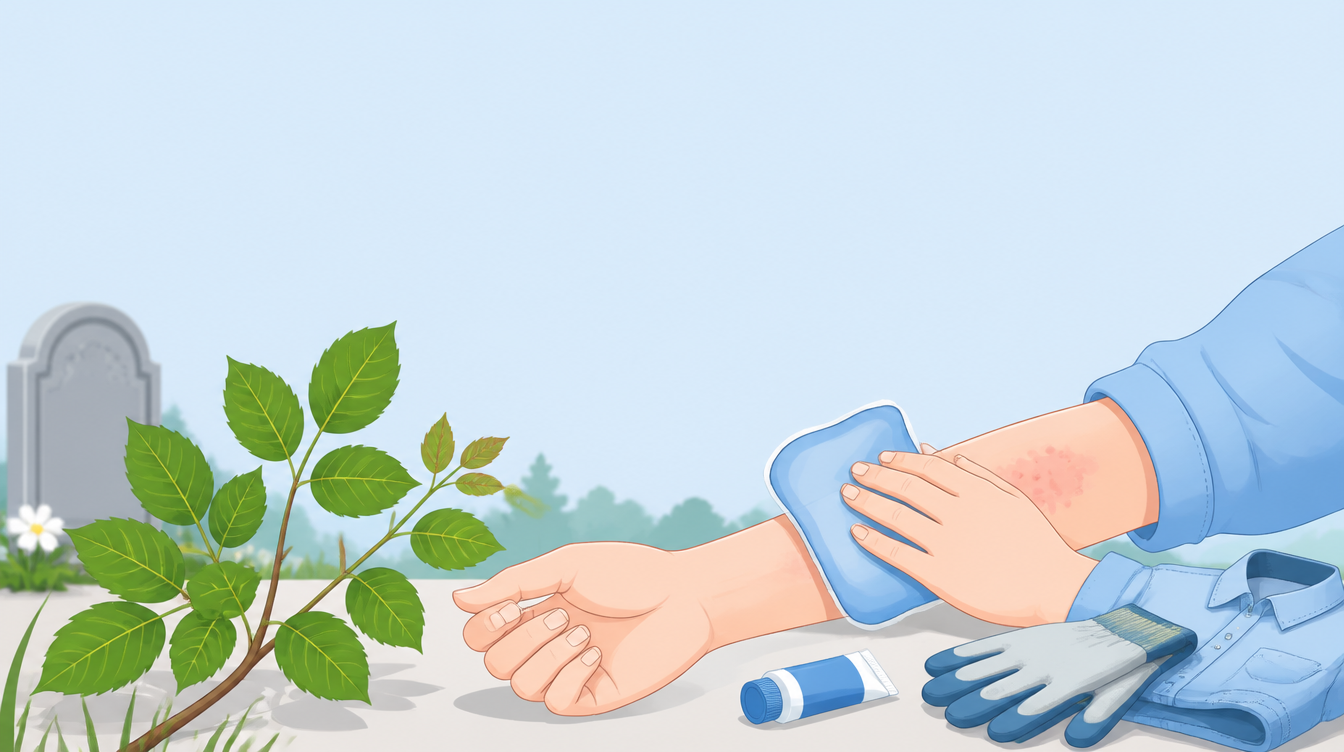
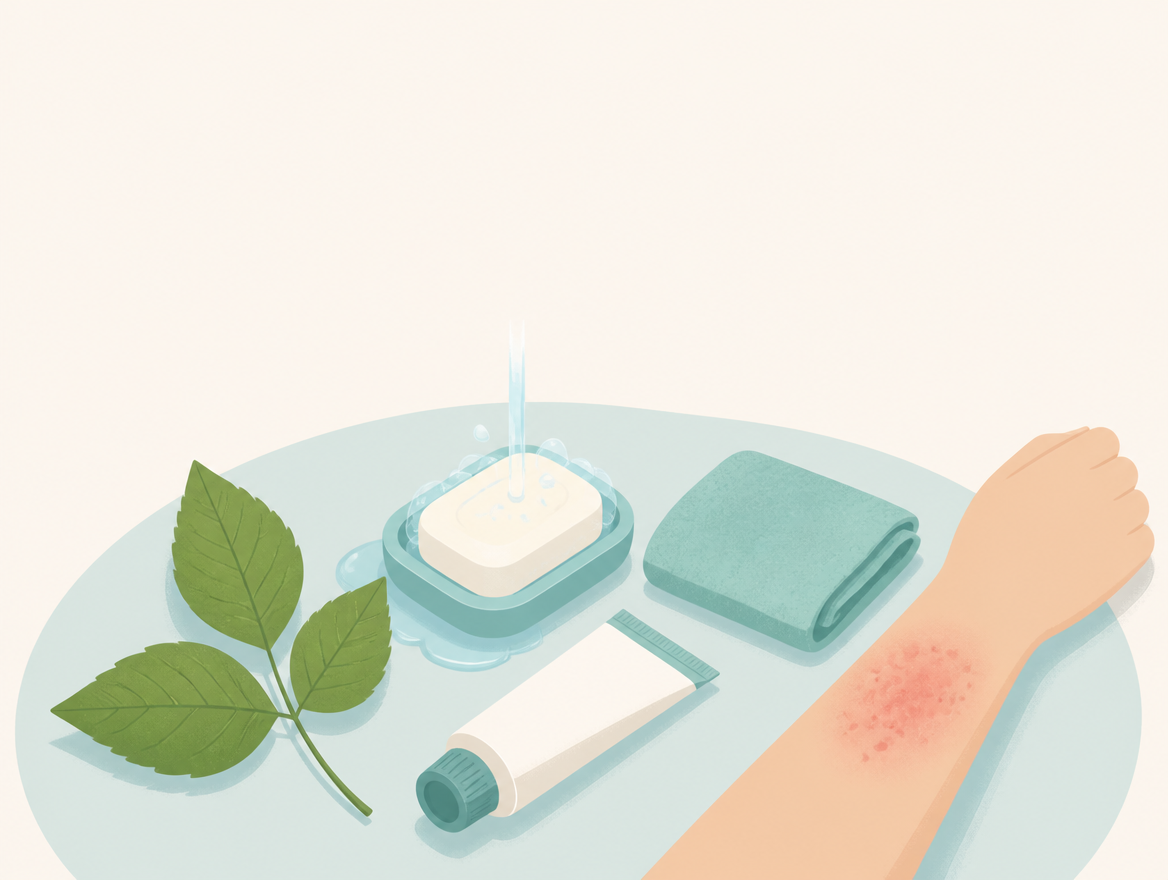
    Poison ivy rash treatment steps for urushiol contact dermatitis after grave cleaning

    Why Does My Skin Itch After Grave Cleaning in Korea?

    Brushing against a lacquer tree’s stem, leaves, or sap-covered tools lets urushiol soak into your skin and trigger an allergic reaction.

    Poison ivy-type dermatitis is an allergic contact rash caused by exposure to urushiol, the oil found in the lacquer tree.

    Urushiol coats the leaves, stems, and roots of the tree, so you don’t have to touch the plant directly — smoke from burning it, or oil transferred onto gloves, clothes, or a sickle, can trigger the same reaction.

    Sensitivity varies from person to person, which is why two people doing the same grave-cleaning work can end up with very different reactions. (Source: Seoul Asan Hospital, 2024)

    Key Point
    You don’t need direct plant contact to get a rash. Urushiol on gloves, a sickle, or a mower blade can trigger it too — so wash your gear after grave cleaning, not just your skin.

    What Are the Symptoms of Poison Ivy-Type Dermatitis?

    Symptoms usually start 8 to 48 hours after contact, showing up as a red, streaky rash and itching along the exposure line, which can progress to blisters and oozing in severe cases.

    Typical poison ivy rash symptoms are clearly defined redness, swelling, and intense itching right where the skin touched the plant.

    Thin-skinned areas like your face, neck, and wrists tend to react more strongly. Scratching can pop blisters and spread fluid to nearby skin.

    That fluid doesn’t actually contain urushiol, so it won’t cause new rashes elsewhere — but swelling near the eyes or neck still needs close attention. (Source: MSD Manuals, 2023)

    Checklist – Signs You Might Have Poison Ivy Rash
    – Rash appeared 8-48 hours after grave cleaning
    – Rash forms in streaks or patchy lines, not scattered dots
    – Intense itching with blisters or oozing
    – Irregular shape, unlike the round welts of an insect bite
    Caution
    If your face swells badly enough that you can barely open your eyes, or you develop trouble breathing or hives all over your body, go to the emergency room right away.

    Poison Ivy Rash Treatment: How Do You Treat It After Grave Cleaning?

    Wash the exposed skin with running water and soap right away to remove the urushiol, then use cold compresses to calm itching and swelling before reaching for an antihistamine or a doctor-prescribed steroid cream if needed. This first-line poison ivy rash treatment works well for most mild cases.

    The longer you wait to wash, the deeper urushiol absorbs into your skin, which can make symptoms worse. (Source: Seoul National University Hospital, 2024)

    Do Don’t
    Wash immediately with running water and soap Use hot water to rinse
    Apply cold compresses or ice packs Scratch or pop blisters
    Change into loose, clean clothes Reuse contaminated clothes or gloves
    See a dermatologist if symptoms are severe Apply folk remedies like soybean paste or alcohol
    Key Point
    Over-the-counter antihistamines or a mild steroid cream are usually enough for a safe poison ivy rash treatment at home. If the rash covers your face or a large area, see a doctor instead of relying on self-treatment.
    Under national health insurance (건강보험, Korea’s public health insurance system), a dermatology visit for this kind of rash is generally an affordable, covered outpatient visit.

    Curious about other skin conditions? Check the Disease Encyclopedia category. (Internal link: to be replaced once a related article is published)


    How Can You Prevent Poison Ivy Rash Before Grave Cleaning?

    Wearing long sleeves, long pants, and gloves to minimize skin exposure, and learning to spot lacquer trees ahead of time, is your best defense.

    Prevention means blocking urushiol contact in the first place through protective clothing and thorough washing before and after the work — but if a rash does break out, starting poison ivy rash treatment right away limits how bad it gets.

    Lacquer trees typically have 5 to 7 glossy leaflets growing opposite each other, so it helps to scan the area before you start cutting. (Source: Ministry of the Interior and Safety, 2024)

    Checklist – Prevention Steps Before and After Grave Cleaning
    – Wear long sleeves, long pants, and waterproof gloves
    – Avoid touching glossy trees with 5-7 leaflets
    – Wash clothes separately and clean skin with soap right after
    – Rinse gloves, sickles, and mower blades with water too
    – If you’ve had a reaction before, talk to a dermatologist beforehand

    Frequently Asked Questions

    1. Is poison ivy rash contagious?
    No. It’s an allergic reaction to urushiol oil, so the rash and blister fluid itself aren’t contagious. But if someone else touches urushiol still on your clothes or tools, they can develop the same rash.

    2. How long does it take to heal?
    Mild cases often improve within one to two weeks, though exposure level and individual sensitivity can stretch that to three weeks or more. See a doctor if it hasn’t improved after two weeks.

    3. Can I pop the blisters?
    It’s best not to. Popping blisters raises your risk of bacterial infection and can slow healing. Manage severe itching with cold compresses or prescribed medication instead.

    4. Do I really need to see a doctor for poison ivy rash treatment?
    Yes, if swelling spreads near your face or eyes, blisters cover a large area, or oozing skin develops pus and warmth, since that can signal infection. Go to the ER if you develop trouble breathing or hives across your whole body.

    References

    • Seoul Asan Hospital (서울아산병원), “Poison Ivy Dermatitis (옻 중독),” 2024. Link
    • Seoul National University Hospital (서울대학교병원), “Lacquer Poison (옻중독),” 2024. Link
    • Ministry of the Interior and Safety of Korea (행정안전부), “Beware of Mower Accidents and Bee Stings Before Chuseok Grave Cleaning,” 2024. Link
    • Mayo Clinic News Network, “Itchy, irritating poison ivy rash,” 2023. Link

    This article is for general informational purposes only and is not a substitute for professional medical advice, diagnosis, or treatment. Please consult a qualified healthcare provider if you have health concerns.
  • Dry Air Nosebleeds: 4 Fall Causes & How to Stop Bleeding Fast

    Dry Air Nosebleeds: 4 Fall Causes & How to Stop Bleeding Fast

    SummaryDry air nosebleeds are common in fall. Learn the 4 real causes, plus the correct way to stop bleeding fast and when to see a doctor.

    You’re washing your face, or you wake up in the middle of the night, and suddenly blood is dripping from your nose. It’s alarming, and most people just shrug it off as “the dry weather.”

    But dry air nosebleeds usually involve more than dryness alone — nose-touching habits and the location of tiny blood vessels inside your nose play a role too. Here’s what actually causes fall nosebleeds and how to stop the bleeding correctly.

    This article covers the main dry air nosebleed causes, the link with seasonal allergies, warning signs that need a doctor, and step-by-step first aid.

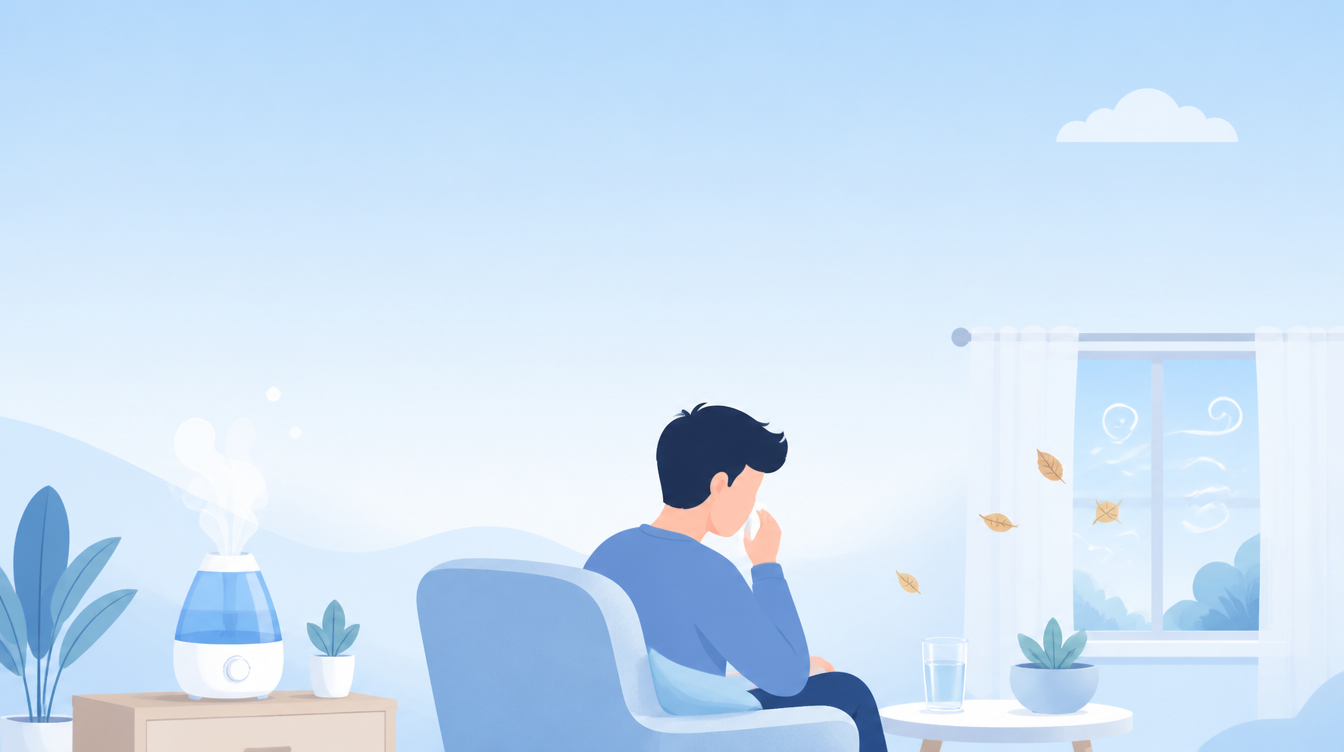
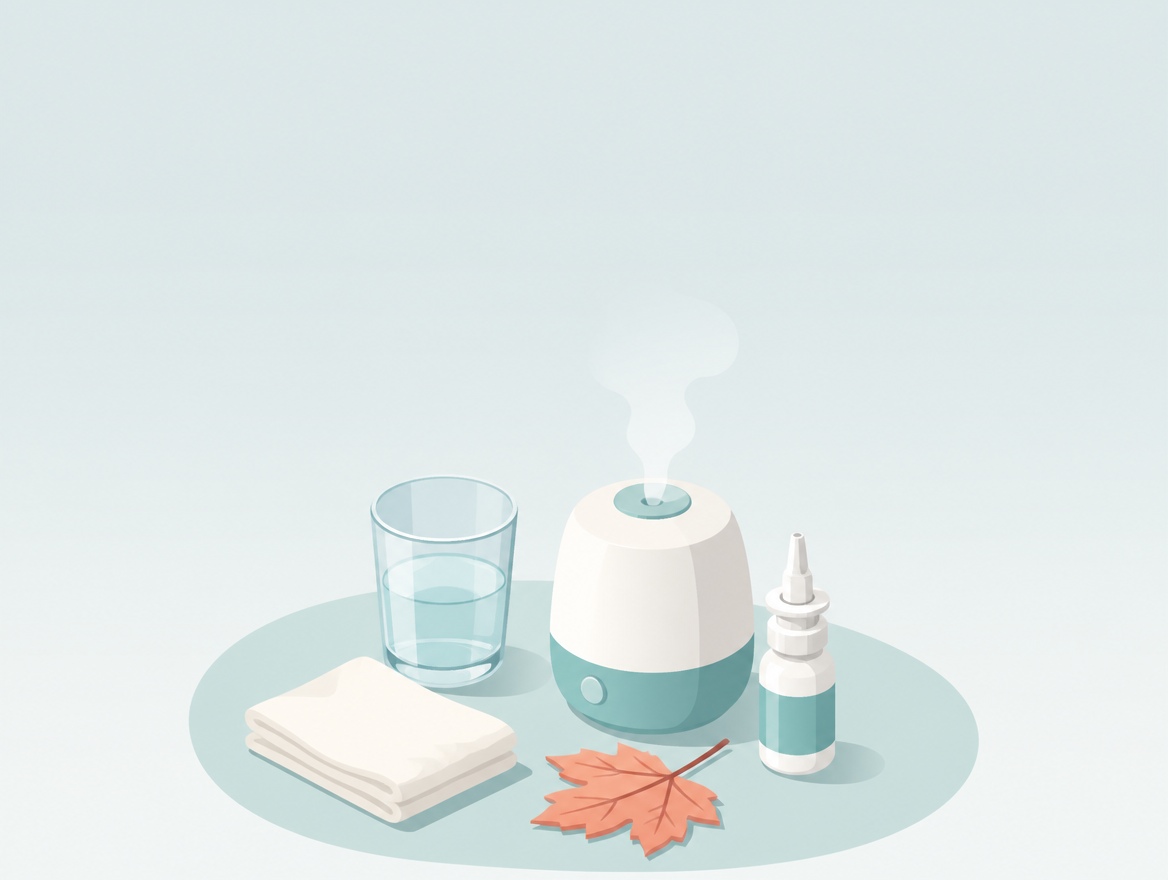
    Illustration showing dry air nosebleed causes and first aid steps

    Why Do Dry Air Nosebleeds Happen More Often in Fall?

    The main reason is simple: dry autumn air dries out the nasal lining, making it crack and bleed more easily.

    A nosebleed (epistaxis) is bleeding from damaged blood vessels inside the nasal lining. According to Cleveland Clinic, most nosebleeds start at the front of the nose, in an area packed with small, fragile blood vessels near the surface.

    Mayo Clinic notes that dry air is one of the two most common triggers for dry air nosebleeds. When the lining dries out, it gets itchy and irritated, so people rub or pick at it without noticing — and that’s often what actually breaks the vessel. (Source: Mayo Clinic)

    Key Point
    It’s rarely the dryness alone. Touching or picking at an already-dry nose is usually the last step before a dry air nosebleed starts.

    Does Seasonal Allergic Rhinitis Raise Your Dry Air Nosebleed Risk in Fall?

    Yes — if you have allergic rhinitis, your fall nosebleed risk can go up.

    Allergic rhinitis is inflammation that happens when your nasal lining overreacts to allergens like pollen or dust. Fall’s swinging temperatures and allergens can flare it up.

    Worse itching means more rubbing and harder nose-blowing, and that repeated friction damages the same fragile vessels near the nostril opening.

    Kids are especially prone to this. Their nasal lining is thinner and holds less moisture than an adult’s, so it dries out faster — and children tend to touch an itchy nose without thinking twice.

    Key Point
    Managing the itch — with an antihistamine, for example — can indirectly cut down on nosebleeds too. Talk to a doctor or pharmacist before starting any medication.

    What’s the Correct Way to Stop a Dry Air Nosebleed Fast?

    Don’t tilt your head back. Sit up, lean slightly forward, and pinch the soft part of your nose for 5 to 10 minutes — that’s the correct first-aid step.

    Stopping a nosebleed means applying enough pressure to the damaged vessel that the blood can clot on its own. Mayo Clinic and Cleveland Clinic both recommend the same basic sequence. (Source: Mayo Clinic, Cleveland Clinic)

    Checklist
    ✅ Sit up and lean your head and body slightly forward
    ✅ Pinch the soft part of your nose with your thumb and index finger
    ✅ Breathe through your mouth and hold for 5–10 minutes without letting go
    ✅ Apply a cold compress to the bridge of your nose or the back of your neck
    ✅ If it’s still bleeding after 10 minutes, pinch again for another 10–15 minutes
    Caution
    Tilting your head back lets blood run down your throat, which can cause gagging or coughing — don’t do it. Spit out any blood that reaches your mouth instead of swallowing it.

    When Do Frequent Dry Air Nosebleeds Mean You Should See a Doctor?

    See a doctor if bleeding won’t stop after 20 minutes of pressure, it happens several times a week, or you’re on blood pressure or blood-thinning medication.

    Cleveland Clinic lists high blood pressure, bleeding disorders, and anticoagulant medications as key risk factors for prolonged nosebleeds. A structural issue inside the nose or a past injury also warrants a checkup. (Source: Cleveland Clinic)

    Caution
    See an ENT specialist if any of these apply to you:
    · Bleeding lasts more than 20 minutes
    · You feel dizzy or look pale
    · You take blood pressure medication or aspirin
    · Nosebleeds keep recurring for no clear reason

    Curious about other conditions too? Check our Disease Encyclopedia. (Internal link: recommend replacing with a related article once published)


    Frequently Asked Questions About Dry Air Nosebleeds

    1. Why do kids get nosebleeds more often than adults?
    Kids have thinner nasal lining and less moisture than adults, so it dries out faster. They also tend to rub or pick at an itchy nose without thinking about it, which leads to more frequent nosebleeds.

    2. Should I tilt my head back during a nosebleed?
    No. Tilting your head back lets blood run down your throat and can cause gagging or coughing. Lean slightly forward instead and pinch the soft part of your nose.

    3. Is there anything I can do at home to prevent nosebleeds?
    Running a humidifier so indoor air doesn’t get too dry, and using a saline nasal spray to keep the inside of your nose moist, can help prevent dry air nosebleeds. Avoid blowing your nose hard or picking at it.

    4. What if the bleeding doesn’t stop after first aid?
    If it’s still bleeding after 10 minutes of pressure, pinch again for another 10–15 minutes. If it still won’t stop after the second try, don’t wait — go to an emergency room.

    References

    (Korea Disease Control and Prevention Agency, 질병관리청), “Nosebleed (Epistaxis)”, 2026. Link
    (Asan Medical Center, 서울아산병원), “Nosebleed”, 2026. Link
    (Mayo Clinic), “Nosebleeds: First aid”, 2026. Link
    (Cleveland Clinic), “Nosebleeds (Epistaxis): Causes, Treatment & Prevention”, 2026. Link

    This article is for general informational purposes only and is not a substitute for professional medical advice, diagnosis, or treatment. Please consult a qualified healthcare provider if you have health concerns.