Table of Contents
When the heat index climbs past 38°C (100°F), the risk of dying from cardiovascular disease rises by 14%, according to a 2026 analysis by Korea’s disease control agency.
Extreme heat isn’t just uncomfortable — it’s a real strain on your heart and blood vessels. Recognizing heat wave heart attack warning signs early matters most if you’re older or already living with heart disease.
This article covers how extreme heat affects your heart, how rising heat index links to heart attack risk, and which symptoms mean you should head to the ER. Knowing the heat wave heart attack warning signs ahead of time helps you react faster during a summer cardiac emergency.
Why does extreme heat strain your heart?
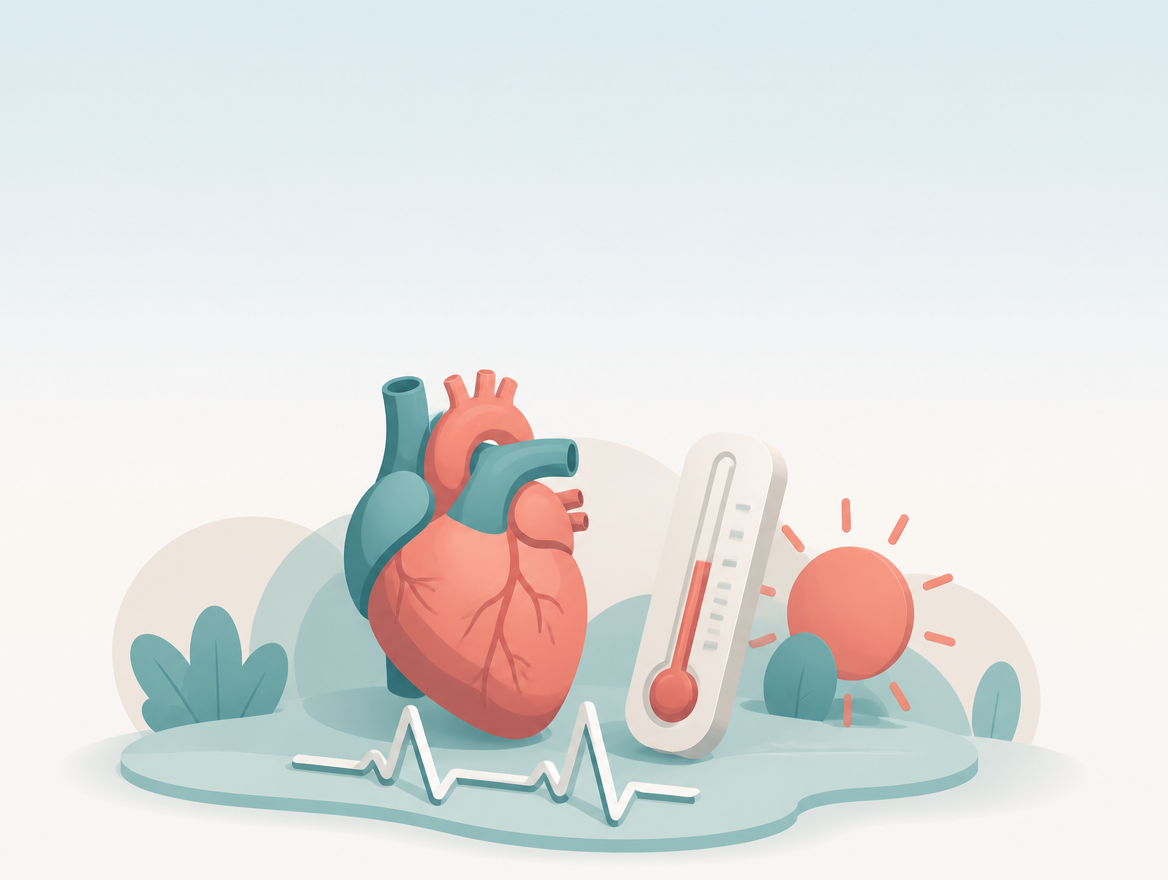
Because your heart has to pump more blood to cool your body down.
Heat stress is the extra strain placed on your cardiovascular system as it works to lower your body temperature in hot conditions. Heavy sweating drains fluid from your body, thickening your blood and raising the odds of clots forming. A clot blocking a coronary artery can trigger a heart attack; one blocking a brain vessel can cause a stroke (Source: American Heart Association, 2026).
Sweating raises your heart rate and breathing rate, and fluid loss thickens your blood — both add real strain to your heart.
Does heart attack risk rise with the heat index?
Yes. As the heat index climbs, so does your risk of a fatal heart attack.
Korea’s disease control agency found that at a heat index of 38°C, overall death risk rises 1.16-fold and cardiovascular death risk rises 1.14-fold (Source: KDCA, July 2026).
| Condition | Risk change |
|---|---|
| Heat index 38°C (extreme heat warning) | Cardiovascular death risk +14% |
| Adults 65 and older | Cardiovascular death risk +14% |
| 4-day heat wave + high pollution (US study) | Fatal heart attack risk up to 2x |
A 2025 European Heart Journal scientific statement similarly found that hospital admissions for heart attacks tend to climb during hot spells, adding weight to the link between extreme heat and cardiac events (Source: European Heart Journal, 2025).
People with existing chronic conditions face a 1.5-fold higher risk of severe heat illness, and adults 80+ face a 1.87-fold higher risk (Source: KDCA, 2026).
What heat wave heart attack warning signs mean you should go to the ER right away?
Yes — chest pain, shortness of breath, or dizziness with cold sweats during extreme heat need immediate medical attention.
Doctors advise people with heart or lung conditions not to “wait it out” during heat waves — if these symptoms appear, seek care right away (Source: Hankook Ilbo, August 2026). In Korea, call 119 (Korea’s emergency hotline, equivalent to 911) for an ambulance; ER visits are partially covered under National Health Insurance (NHI, Korea’s universal public health insurance).
✅ Sudden chest pain or pressure
✅ Shortness of breath
✅ Dizziness or fainting with cold sweats
✅ Pain spreading to arm, shoulder, or jaw
✅ Unusual, severe weakness
Moving from extreme outdoor heat straight into strong AC can make your dilated blood vessels suddenly constrict, adding strain to your heart. Ease into temperature changes when possible.
What precautions protect your cardiovascular health during a heatwave?
Start with steady hydration and cutting back on outdoor activity during peak heat hours.
If you have heart disease, some medications affect your body’s fluid and electrolyte balance, so ask your doctor or pharmacist whether your hydration habits or medication schedule need adjusting during a heat wave.
✅ Sip water often in small amounts (ask your doctor first if you have heart failure or kidney disease)
✅ Limit outdoor activity from noon to 5 p.m.
✅ Ease indoor-outdoor temperature gaps to 5–6°C
✅ Never change your heart medication dose on your own
✅ Call 119 immediately if warning signs appear
You can find more heat-related condition guides in our related category. Browse Disease Encyclopedia (Internal link: recommend replacing once a related article is published)
Frequently Asked Questions
Q1. Should people with heart disease avoid outdoor exercise during a heat warning?
A. Cutting back on outdoor activity between noon and 5 p.m. can help. Talk to your doctor about safe exercise intensity and timing.
Q2. Can heart palpitations or dizziness during a heat wave be cardiovascular warning signs?
A. They can be. If cold sweats or unusual weakness appear alongside them, get checked at a medical facility.
Q3. Can strong air conditioning hurt your heart?
A. Moving quickly from extreme heat into strong AC can make blood vessels constrict suddenly, straining the heart. Ease the transition when you can.
Q4. Should I worry about heat even without a history of heart disease?
A. Yes. Age and dehydration alone can raise your risk, so steady hydration and rest still matter.
Q5. How much water should I drink during a heat wave?
A. The right amount depends on your heart and kidney health, so ask your doctor for guidance specific to you.
References
(Korea Disease Control and Prevention Agency), “Precautions for People Vulnerable to Extreme Heat” (원제: 폭염에 취약한 분들, 이렇게 대비하세요), press release, 2026 Link
(Hankook Ilbo), “Heart and Lung Patients at Higher Risk During Heat Waves” (원제: 폭염에 더 위험한 심장·폐 질환자), 2026 Link
(American Heart Association), “When the heat rises, so do heart risks”, 2026 Link
(CDC), “Clinical Overview of Heat and Cardiovascular Disease” Link
(European Heart Journal), “Heat extremes and cardiovascular diseases: a scientific statement of the ESC”, 2025 Link
This article is for general informational purposes only and is not a substitute for professional medical advice, diagnosis, or treatment. Please consult a qualified healthcare provider if you have health concerns.
Leave a Reply