Table of Contents
Notice more hair on your pillow or hairbrush every fall? You’re not imagining it.
Research consistently shows that hair shedding follows a seasonal pattern, peaking in late summer and early fall. Understanding seasonal hair loss in fall helps you tell normal shedding apart from something that needs a dermatologist’s attention.
This article covers why seasonal hair loss in fall happens, how long it lasts, how to tell it apart from conditions needing treatment, and practical ways to manage it — based on published research and Korean health data.
Why does hair loss get worse in fall?
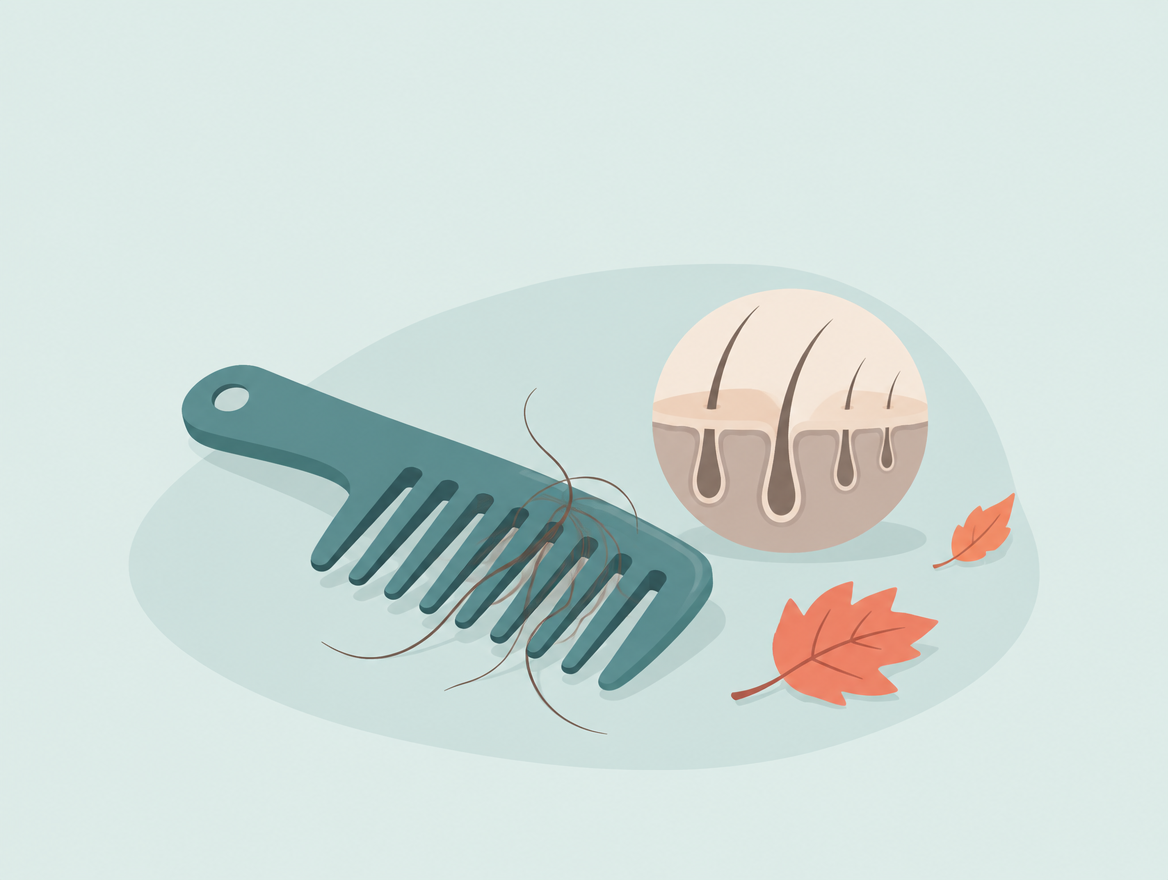
It’s the combined effect of summer UV damage to hair follicles and a hormonal shift triggered by shorter daylight hours, which pushes many hairs into their resting phase at once.
Telogen effluvium is a condition where a large number of hair follicles shift into the resting (telogen) phase at the same time, causing noticeable shedding weeks later.
According to published research, late summer through early fall (August–October) is when the proportion of resting-phase hair is highest during the year. Fall hair loss usually isn’t caused by a single factor — several combine at once.
Fall hair loss results from a combination of summer UV damage, hormonal shifts from reduced daylight, dry scalp conditions, and nutritional imbalance.
| Cause | Explanation |
|---|---|
| Less daylight | Shorter days shift hormone rhythms, pushing growth-phase hairs into rest. |
| Summer UV damage | Sun, sweat, and oil buildup from summer weaken follicles by fall. |
| Dry scalp | Drier air and big temperature swings disrupt the scalp’s moisture balance. |
| Nutrition and stress | Low protein, iron, zinc, or vitamins, plus stress, can affect the hair cycle. |
Source: International Journal of Trichology, “Comment on Seasonal Hair Shedding,” 2024
How long does fall hair loss last?
Most seasonal hair loss settles on its own within three to six months, without treatment.
Clinical sources note that losing 50 to 100 hairs a day is normal, and seasonal shedding tends to peak around September.
Research reviews confirm that acute telogen effluvium typically stops three to six months after the triggering factor goes away. The increase is temporary — overall hair density usually doesn’t drop noticeably.
Fall hair loss typically peaks around September and resolves on its own within three to six months once the trigger fades.
Source: National Library of Medicine (NIH, PMC), “Telogen Effluvium: A Review of the Literature,” 2020
How can you tell normal shedding from hair loss that needs a doctor?
Even shedding under 100 hairs a day that fades within a few months is usually normal. Patchy thinning or heavy shedding lasting over six months needs medical evaluation.
Normal seasonal hair loss is temporary shedding that recovers on its own without treatment. Genetic conditions like androgenetic (male or female pattern) alopecia and alopecia areata, however, progress regardless of season and need separate diagnosis and care.
See a dermatologist if you notice:
· Shedding over 100 hairs a day for more than six months
· Round bald patches or visible scalp thinning
· Severe itching, redness, or flaking on the scalp
· A family history combined with a receding hairline or crown
Source: Cleveland Clinic, “Telogen Effluvium: Symptoms, Causes, Treatment & Regrowth,” 2024
What are the best ways to manage seasonal hair loss in fall?
Scalp hydration, balanced nutrition, sun protection, and stress management form the basics of managing seasonal hair loss in fall.
Managing seasonal hair loss is not about stopping shedding entirely — it’s about keeping your scalp environment healthy so follicles can move smoothly into their next growth phase.
✅ Use a gentle shampoo and rinse thoroughly
✅ Apply scalp moisturizer or oil to fight dryness
✅ Eat enough protein, zinc, iron, B vitamins, and vitamin D
✅ Wear a hat or use an umbrella to protect your scalp from UV
✅ Get enough sleep and manage stress to keep hormones balanced
If shedding doesn’t noticeably improve with these habits, an accurate diagnosis from a dermatologist matters more than self-care alone. (Internal link: recommend replacing with a related article once published)
Frequently Asked Questions
1. Does fall hair loss happen to women too?
Yes. Among roughly 248,000 patients treated for hair loss in Korea in 2022, per Health Insurance Review & Assessment Service (HIRA — Korea’s national health claims review agency) data, 110,469 were women, close to the 137,446 men. Seasonal hair loss can affect anyone regardless of gender.
2. Which nutrients can help with fall hair loss?
Protein, zinc, iron, B vitamins, and vitamin D may support follicle health. No single supplement can be said to cure hair loss, though — a balanced diet should come first.
3. Can stress make fall hair loss worse?
Chronic stress is a known factor that can push hair from the growth phase into the resting phase. Combined with seasonal changes, it may make shedding feel more noticeable.
4. Does alopecia areata also get worse in fall?
Alopecia areata is an autoimmune condition with a different mechanism than seasonal telogen effluvium. Season isn’t a direct cause, though stress may influence symptoms — see a dermatologist if you suspect alopecia areata.
References
Health Insurance Review & Assessment Service (HIRA, 건강보험심사평가원), “Statistics on Hair Loss Patient Treatment,” 2023. Link
Cleveland Clinic, “Telogen Effluvium: Symptoms, Causes, Treatment & Regrowth,” 2024. Link
National Library of Medicine (NIH, PMC), “Telogen Effluvium: A Review of the Literature,” 2020. Link
International Journal of Trichology, “Comment on Seasonal Hair Shedding,” 2024. Link
This article is for general informational purposes only and is not a substitute for professional medical advice, diagnosis, or treatment. Please consult a qualified healthcare provider if you have health concerns.
Leave a Reply