Table of Contents
You bundle up in a jacket for your morning coffee, then you’re sweating by lunch. Sound familiar?
If your arms or neck suddenly turn red and itchy along the way, you might be dealing with seasonal hives. As fall brings bigger swings between morning and afternoon temperatures, hives become a lot more common — and it’s not just “sensitive skin.”
Seasonal hives happen when big temperature swings trigger the skin’s mast cells to release histamine, usually through the autonomic nervous system. Antihistamines and simple temperature control often calm things down, but if hives keep coming back for more than 6 weeks, it may be chronic urticaria that needs a doctor’s evaluation.
Why Do Seasonal Hives Show Up When the Weather Changes?
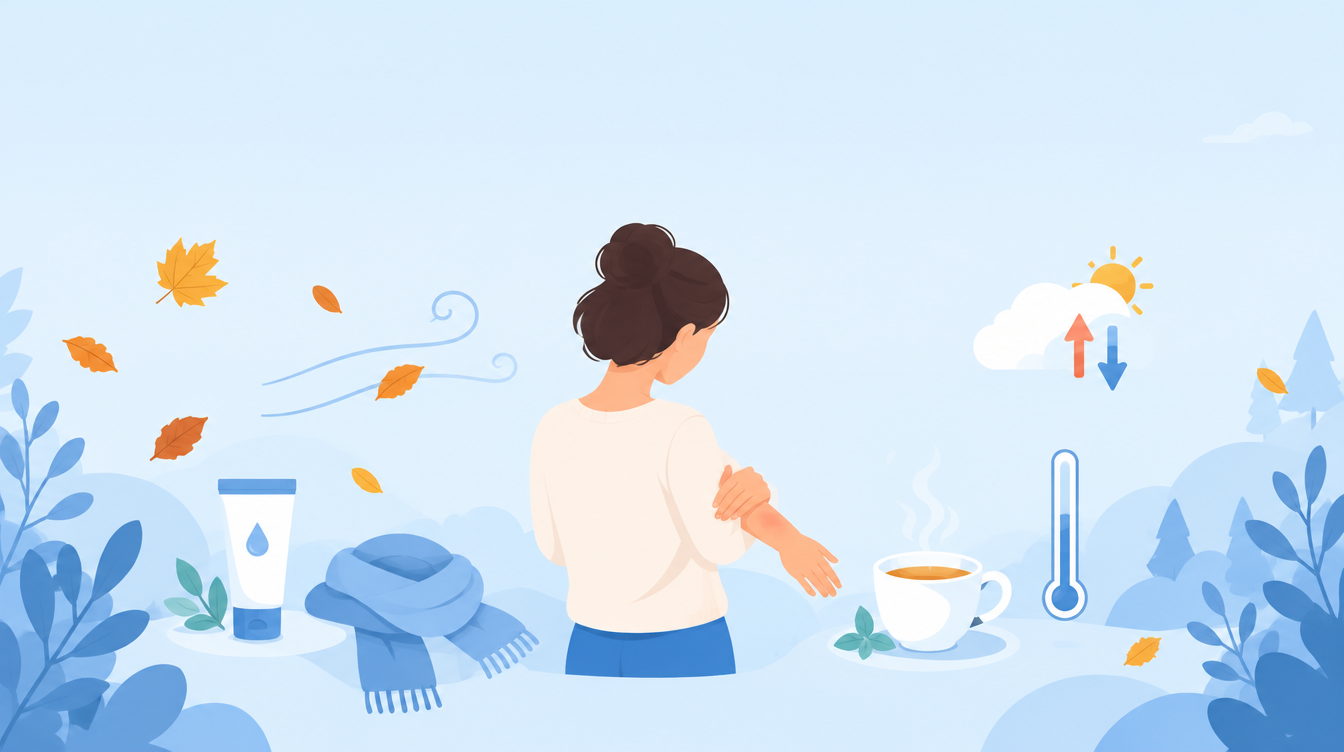
Big swings between morning and afternoon temperatures throw your autonomic nervous system off balance. That triggers your skin’s mast cells to release too much histamine, which causes hives.
Hives are an allergic skin reaction where surface blood vessels widen and fluid builds up around them, creating raised, itchy welts. In fall, mornings and afternoons in Korea can differ by more than 10°C (18°F), and that shift alone is enough to irritate sensitive skin.
Big temperature swing → autonomic nervous system disruption → mast cells release histamine → welts and itching.
Source: Seoul Asan Medical Center, “Urticaria”
Is Seasonal Hives the Same as Cold Urticaria?
No. With seasonal hives, the temperature change itself is the trigger. With cold urticaria, cold air or cold water is the direct trigger — not the shift.
Cold urticaria is a physical form of hives where histamine is released as soon as skin is suddenly exposed to low temperatures, causing welts. Both types respond to antihistamines, but knowing which one you have matters for prevention.
| Type | Seasonal Hives | Cold Urticaria |
|---|---|---|
| Main trigger | Temperature swings up and down | Cold air, cold water, low temperature itself |
| Common season | Spring and fall | Winter, or contact with cold water |
| Simple check | Track symptoms before/after going outside | Ice cube test (done at a clinic) |
Same first-line treatment, different trigger — track whether hives appear during temperature shifts or only in cold conditions.
Source: Seoul Asan Medical Center, “Cold Urticaria”; Mayo Clinic, “Cold urticaria – Symptoms and causes”
If Hives Last Over 6 Weeks, Is It Chronic Urticaria — and How Do You Manage It?
Yes. If welts and itching show up daily or on and off for more than 6 weeks, that’s classified as chronic urticaria, and it calls for a doctor’s care and step-up treatment.
Chronic urticaria is hives with welts and itching that persist or recur for 6 weeks or longer, often without an obvious cause. The AAAAI/ACAAI guideline recommends starting with a standard-dose second-generation antihistamine, then increasing the dose — up to fourfold — under a doctor’s guidance if symptoms don’t improve.
In Korea, a dermatology or allergy clinic visit for hives is typically covered by the National Health Insurance (NHI) — Korea’s mandatory public health insurance for residents — which keeps out-of-pocket costs relatively low.
| Step | Treatment |
|---|---|
| Step 1 | Standard-dose second-generation antihistamine |
| Step 2 | Up to 4x dose increase, under a doctor’s guidance |
| Step 3 | Additional therapy considered if there’s no response |
If hives keep recurring past 6 weeks, don’t adjust your own medication — see a dermatologist or allergist for proper evaluation.
Source: AAAAI/ACAAI, “Diagnosis and Management of Acute and Chronic Urticaria”; Seoul Asan Medical Center, “Chronic Urticaria”
How Can You Prevent and Manage Seasonal Hives at Home?
Reducing indoor-outdoor temperature gaps and easing skin irritation can lower how often hives show up.
A light jacket for cool mornings and evenings is the simplest way to keep your body temperature from dropping too fast in fall.
✅ Carry a light jacket to smooth out temperature swings
✅ Wash and shower with lukewarm water — skip hot showers and saunas
✅ Choose cotton over synthetic fabrics
✅ Sip lukewarm water throughout the day
✅ Cut back on instant food and high-fat meals, and get enough sleep
When itching gets bad, a cool damp compress usually helps more than scratching — unless you suspect cold urticaria, in which case warming up is the better move. For more on related conditions, visit our Disease Encyclopedia category. (Internal link: recommended to replace once a related article is published.)
Source: Seoul Asan Medical Center, “Urticaria”
Frequently Asked Questions
1. Is it normal for hives to appear and disappear several times a day?
Yes — individual welts typically clear within 24 hours without leaving a mark, which is a normal pattern for hives. If the same spot stays swollen for more than a day or leaves a bruise-like mark, see a doctor to rule out other conditions.
2. Is it okay to take antihistamines every day for hives?
Second-generation antihistamines cause less drowsiness and are generally considered suitable for longer-term use, but you should always confirm the dose and duration with a doctor or pharmacist.
3. Can stress make seasonal hives worse?
Stress can affect histamine release and autonomic nervous system responses, so it’s considered one of the factors that can worsen symptoms. Getting enough sleep and rest may help.
4. Is it okay to wash the affected area with hot water?
Hot water widens blood vessels and can make itching and welts worse, so lukewarm water is recommended. Unless you suspect cold urticaria, a cool compress can also help.
References
(Seoul Asan Medical Center), “Urticaria” (두드러기), Link
(Seoul Asan Medical Center), “Chronic Urticaria” (만성 두드러기), Link
(Seoul Asan Medical Center), “Cold Urticaria” (한랭 두드러기), Link
(Mayo Clinic), “Cold urticaria – Symptoms and causes”, 2024, Link
(AAAAI/ACAAI, Guideline Central), “Diagnosis and Management of Acute and Chronic Urticaria”, Link
This article is for general informational purposes only and is not a substitute for professional medical advice, diagnosis, or treatment. Please consult a qualified healthcare provider if you have health concerns.
Leave a Reply