
Table of Contents
Your child had a runny nose all week, then suddenly cried all night tugging at one ear. It’s a jarring switch for any parent. As temperatures swing between warm days and cold nights, kids catch more colds — and colds often turn into ear infections. Learning to recognize ear infection symptoms in children early can help you get treatment started sooner. It’s easy to write off as “just a cold,” but knowing the early signs matters.
This guide covers why acute otitis media in children spikes in fall, the main symptoms including ear pain, how to tell it apart from a cold, and when it’s time to see a doctor. If your child keeps touching their ear or waking up at night, start with the checklist below.
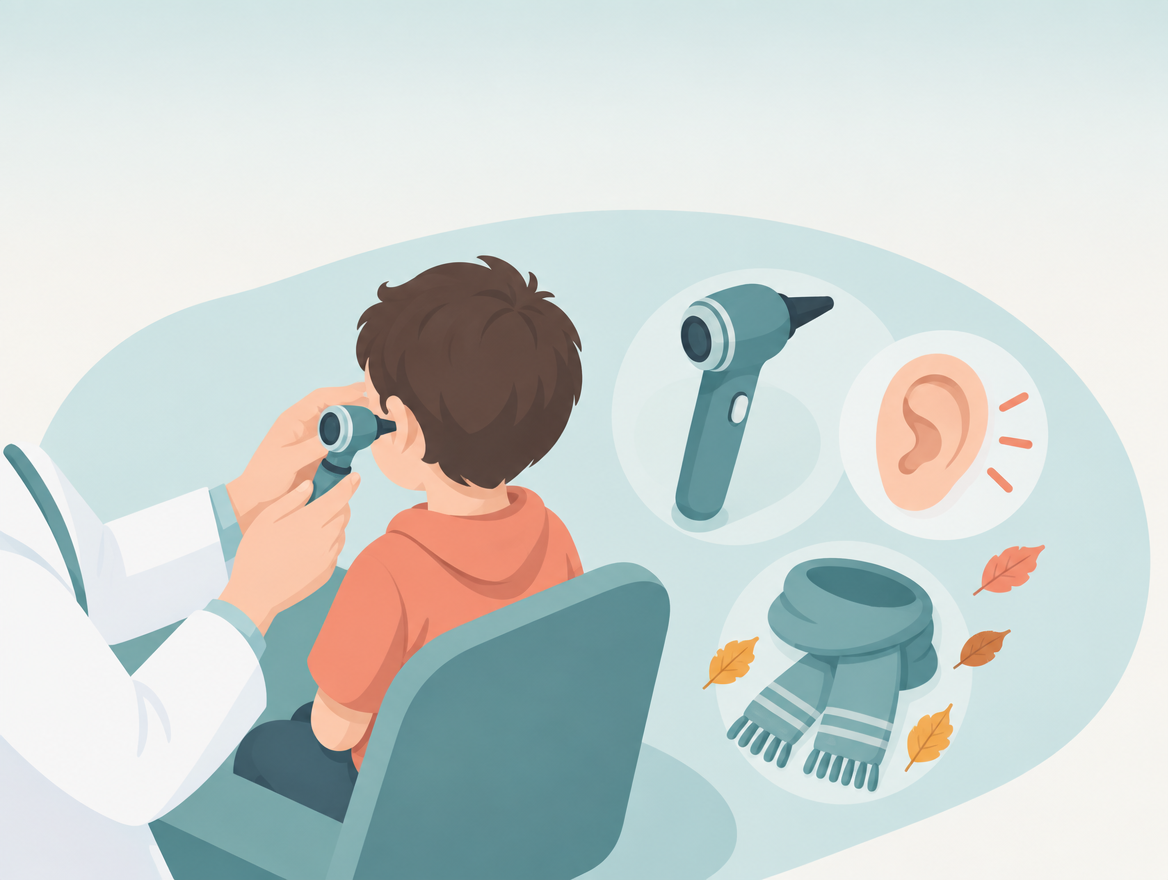
Why do kids get ear infections so often when seasons change?
Big temperature swings weaken kids’ immunity and lead to more colds — and more colds mean more ear infections.
Acute otitis media is an infection of the middle ear, behind the eardrum, usually caused by bacteria or a virus. According to Mayo Clinic, it often develops when germs from a cold travel through the eustachian tube — the passage connecting the middle ear to the back of the throat — into the middle ear.
Kids’ eustachian tubes are shorter and more horizontal than adults’, so infections spread more easily. Combine that with more frequent colds during seasonal transitions, and it’s no surprise ear infections spike in fall.
Ear infections almost always start as a cold. If your child suddenly spikes a fever or complains of ear pain a few days into a cold, it’s worth checking for otitis media.
Source: Mayo Clinic, Seoul Asan Hospital Disease Encyclopedia
What are the main ear infection symptoms in children?
The most common signs are sudden ear pain and fever. These early ear infection symptoms in children are easy to miss if you don’t know what to look for. Babies and toddlers who can’t talk yet may tug at an ear or become unusually fussy.
Ear pain, or otalgia, is the classic warning sign of acute otitis media. Per Mayo Clinic, other symptoms can include trouble hearing, fluid draining from the ear, trouble sleeping, reduced appetite, and even loss of balance.
A typical pattern: a child has cold symptoms for a few days, then suddenly develops a fever along with ear pain or hearing trouble. That combination is a hallmark of acute otitis media.
✅ Your child keeps touching or pulling at their ear
✅ Fever spikes back up near the end of a cold
✅ They seem to hear less or turn the TV volume way up
Source: Mayo Clinic, Seoul Asan Hospital Disease Encyclopedia
How can you tell a cold from an ear infection, and when should you see a doctor?
If your child’s cold symptoms were improving and then their fever suddenly climbs again along with ear pain, it’s time to see a doctor.
A plain cold gradually gets better — the runny nose and cough ease up day by day. An ear infection often shows up as a second wave: fever returns and ear symptoms appear right when the cold seemed to be fading. Early symptoms can overlap with other respiratory infections, so a proper diagnosis needs a doctor to examine the eardrum.
See a doctor promptly if:
· Your baby is under 6 months old and has a fever
· Fever stays above 102.3°F (39°C)
· Fluid or pus drains from the ear
· Pain is severe enough to disrupt sleep or cause constant crying
Source: American Academy of Pediatrics (AAP) guideline, CDC
How is pediatric ear infection treated, and how can you prevent it?
Pain relief comes first. Whether and when to use antibiotics depends on your child’s age and symptom severity, and that call belongs to a doctor.
Watchful waiting means holding off on antibiotics for two to three days to see if mild symptoms resolve on their own. The AAP recommends considering this approach for certain age groups and symptom levels — but it’s a clinical decision, not something to decide at home.
At home, use pain relievers as your doctor recommends, and make sure your child stays hydrated and rests comfortably. For prevention, frequent handwashing, avoiding secondhand smoke exposure, staying current on flu and pneumococcal vaccines, and not feeding a baby a bottle while lying flat can all help.
Mild symptoms don’t automatically mean your child needs antibiotics. For children with frequent, recurring ear infections, ask an ENT specialist about options like ear tube surgery.
Source: American Academy of Pediatrics (AAP), CDC
For more on related pediatric conditions, browse our Disease Encyclopedia category. (Internal link: to be replaced with a related article once published)
Frequently Asked Questions
1. Can my child still take baths with an ear infection?
If there’s no eardrum rupture, regular baths are fine — just be careful not to get a lot of water directly into the ear. If a rupture is suspected, check with your doctor first.
2. Can a child have an ear infection without a fever?
Yes. Some kids only show ear pain or a feeling of fullness without fever, so it’s worth getting checked if your child keeps touching their ear — ear infection symptoms in children can appear even without a temperature.
3. How many days of antibiotics does my child need?
Duration depends on age, symptoms, and the specific bacteria involved. Follow your doctor’s prescribed course fully — don’t stop early even if symptoms improve.
4. What if ear infections keep coming back?
For children with frequent recurrences, talk to an ENT specialist about whether additional treatment, such as ear tube placement, is needed.
References
(Seoul Asan Hospital, Korea), “Acute Otitis Media (급성 중이염),” Disease Encyclopedia. Link
(Korea Disease Control and Prevention Agency), “Otitis Media (중이염),” National Health Information Portal. Link
(Mayo Clinic), “Ear infection (middle ear) – Symptoms & causes.” Link
(American Academy of Pediatrics), “The Diagnosis and Management of Acute Otitis Media,” Pediatrics, 2013. Link
(CDC), “Ear Infection Basics.” Link
(Health Kyunghyang, Korea), “Seasonal Illness: Otitis Media Arrives Every Change of Season (환절기면 어김없이 찾아오는 ‘중이염’).” Link
This article is for general informational purposes only and is not a substitute for professional medical advice, diagnosis, or treatment. Please consult a qualified healthcare provider if you have health concerns.
Leave a Reply