
Table of Contents
Sneezing and a runny nose that won’t quit, but no idea what’s causing it? You’re not alone.
Ragweed and mugwort pollen peak from August through October, making them common triggers of fall allergic rhinitis.
Without knowing the exact cause, it’s hard to know what to avoid or how to treat it. That’s why understanding allergy test types matters.
This article compares the main allergy test types — the skin prick test and the specific IgE blood test — including how accurate each one is, plus when a patch test or oral food challenge is needed instead. We’ll also cover what to expect from each test.
Why Do Allergy Test Types Matter for Finding Your Fall Trigger?
Because knowing the exact trigger is what lets you build an avoidance plan and choose the right treatment.
An allergy test is a way to check whether your immune system reacts to a specific substance, called an allergen. Symptoms alone can’t tell you whether pollen, dust mites, pet dander, or food is the culprit.
In fall, weed pollens like ragweed and mugwort are frequent causes, so narrowing down the trigger through testing helps you and your doctor decide on avoidance and medication.
A positive result doesn’t automatically mean that allergen causes your symptoms. It shows “sensitization” — your doctor combines it with your history and symptoms to make a diagnosis. (Source: ACAAI)
What Is a Skin Prick Test?
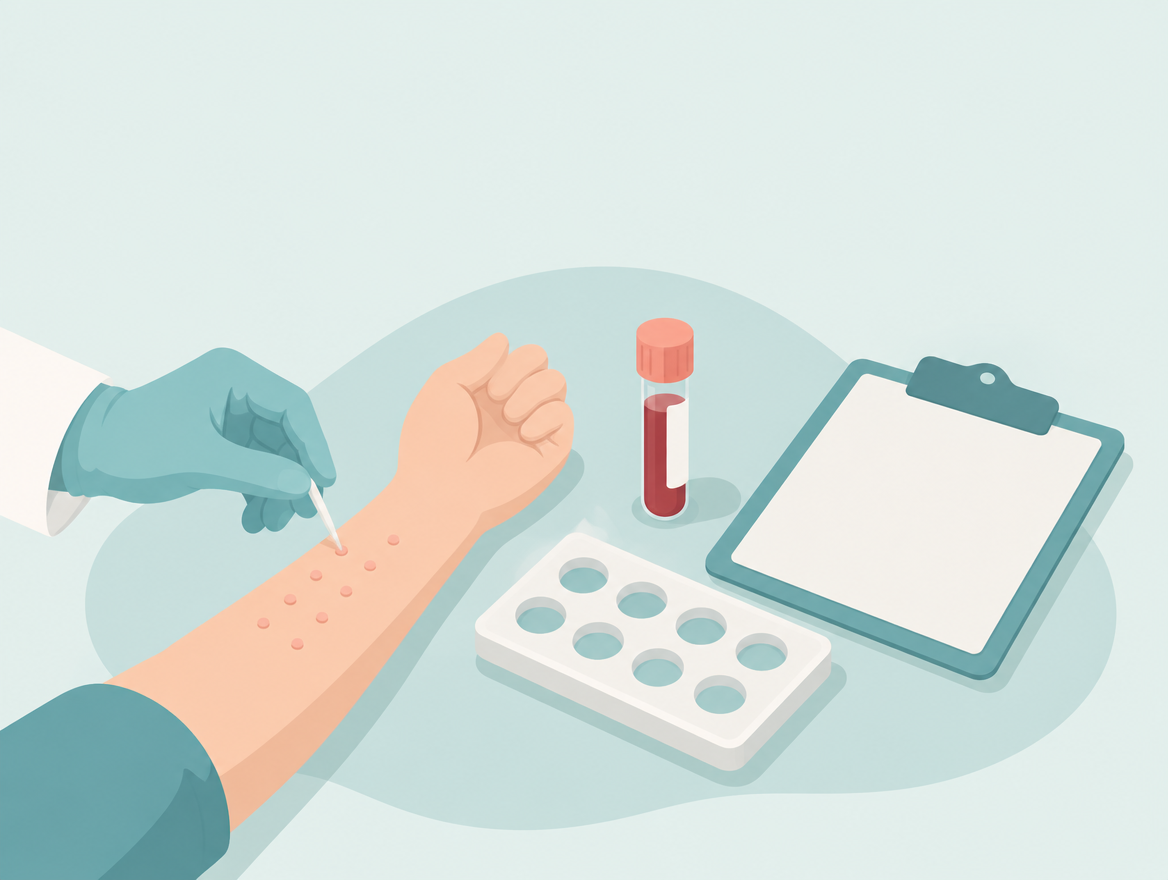
A skin prick test involves placing a drop of suspected allergen extract on your skin, then lightly pricking it so the extract enters the top layer.
You’ll see results within 15 to 20 minutes based on whether a small raised bump forms, which is why it’s the most common first-line allergy test.
You typically need to stop antihistamines for several days beforehand — taking them can cause false negatives.
A meta-analysis on allergic rhinitis found skin prick testing has a sensitivity of 85% and a specificity of 77%. (Source: PMC, 2016)
✅ Stop antihistamines a few days ahead, as your doctor advises
✅ Testing may be difficult if you have active skin conditions like severe eczema
✅ Pregnant patients and infants should discuss timing with a provider first
How Accurate Is an Allergy Blood Test?
An allergy blood test, or specific IgE test, measures antibodies your blood produces against a particular allergen.
It’s more reproducible than a skin prick test and offers high specificity, which is why doctors favor it when you’re on antihistamines, have skin conditions that rule out skin testing, or have a high risk of anaphylaxis. (Source: ACAAI)
In Korea, a multi-allergen screening panel called MAST is also common — it’s a semi-quantitative screening tool that’s generally less sensitive than individual specific IgE testing. (Source: GC Labs Korea)
There’s no single answer to which test is “more accurate.” Age, medications, skin condition, and the suspected allergen all determine which test fits you best.
When Do You Need a Patch Test or Oral Food Challenge?
A patch test involves taping allergens onto your back for 48 to 72 hours to check for a delayed contact reaction. It’s used to find causes of contact dermatitis, like nickel or cosmetic ingredients. (Source: Mayo Clinic)
When food allergy is suspected, the oral food challenge is considered the gold standard for diagnosis. Under medical supervision, you eat the suspected food in small, gradually increasing amounts while your reaction is monitored — this must always be done at a medical facility. (Source: NIAID)
| Test | Best For | Time | Notes |
|---|---|---|---|
| Skin prick test | Inhaled allergens (pollen, dust mites) | 15-20 min | Fast, low-cost; affected by antihistamines |
| Specific IgE blood test | Inhaled and food allergens | Days (lab turnaround) | Unaffected by skin/meds; highly reproducible |
| MAST panel | Screening multiple allergens at once | Days | Semi-quantitative screening tool |
| Patch test | Contact dermatitis triggers | 48-72 hours | Detects delayed reactions |
| Oral food challenge | Confirming food allergy | Hours, at a clinic | Gold standard; requires medical supervision |
Oral food challenges carry a risk of severe reactions like anaphylaxis, so they must only be done at a facility equipped for emergency care. Never attempt one at home.
For more on allergy testing options, browse our Exams & Procedures Guide category. (Internal link: recommended to replace with a related article once published)
Frequently Asked Questions
1. Do I need to stop antihistamines before a skin prick test?
Yes, doctors usually recommend stopping 3 to 7 days beforehand. If you’re on any medication, ask your provider when to pause it before testing.
2. Can I still have an allergy even if the test comes back negative?
It’s rare but possible. Timing, the specific allergen, and the limits of each test method can produce a false negative, so persistent symptoms may warrant retesting or a different test.
3. What age can allergy testing start?
Blood tests can be done even in infants, while skin prick testing is typically available from around 6 months of age, with the exact approach decided by a pediatrician or allergist based on the child’s condition.
4. Is allergy testing covered by insurance in Korea?
Korea’s national health insurance (a public health coverage system that most residents are enrolled in) may cover testing when a doctor determines it’s medically necessary for diagnosing or treating an allergic condition, but many tests are billed as non-covered items depending on the facility and test type — check before your visit. (Source: National Health Insurance Service)
5. If several allergens test positive, do I need to avoid all of them?
Not necessarily. A positive result only shows sensitization, not that the substance definitely triggers your symptoms. Don’t restrict multiple foods or items on your own — discuss the results with your doctor first.
References
(Cleveland Clinic), “Allergy Testing: Purpose, Types, Indications & Results,” 2023. Link
(ACAAI), “What’s the difference between skin testing and blood tests for allergies?” 2023. Link
(PMC), “Diagnostic accuracy of skin-prick testing for allergic rhinitis: a systematic review and meta-analysis,” 2016. Link
(NIAID), “Diagnosing Food Allergy.” Link
(Mayo Clinic), “Patch testing for contact dermatitis.” Link
(GC Labs Korea), “Understanding MAST Test Coverage Criteria and Allergy Results” (MAST 검사 급여기준과 알레르기 검사결과의 이해). Link
(Seoul Asan Medical Center), “Allergic Rhinitis” (알레르기 비염) Disease Encyclopedia. Link
This article is for general informational purposes only and is not a substitute for professional medical advice, diagnosis, or treatment. Please consult a qualified healthcare provider if you have health concerns.
Leave a Reply