Table of Contents
Every summer, South Korea’s Korea Disease Control and Prevention Agency (KDCA) issues a national Japanese encephalitis (JE) alert. In 2025, the first domestic JE patient of the year was reported, and additional adult cases followed. Many adults assume JE vaccination is only for children — but if you never completed the full vaccination schedule, you may still be at risk. There is no treatment for JE, which makes vaccination the only reliable form of protection.
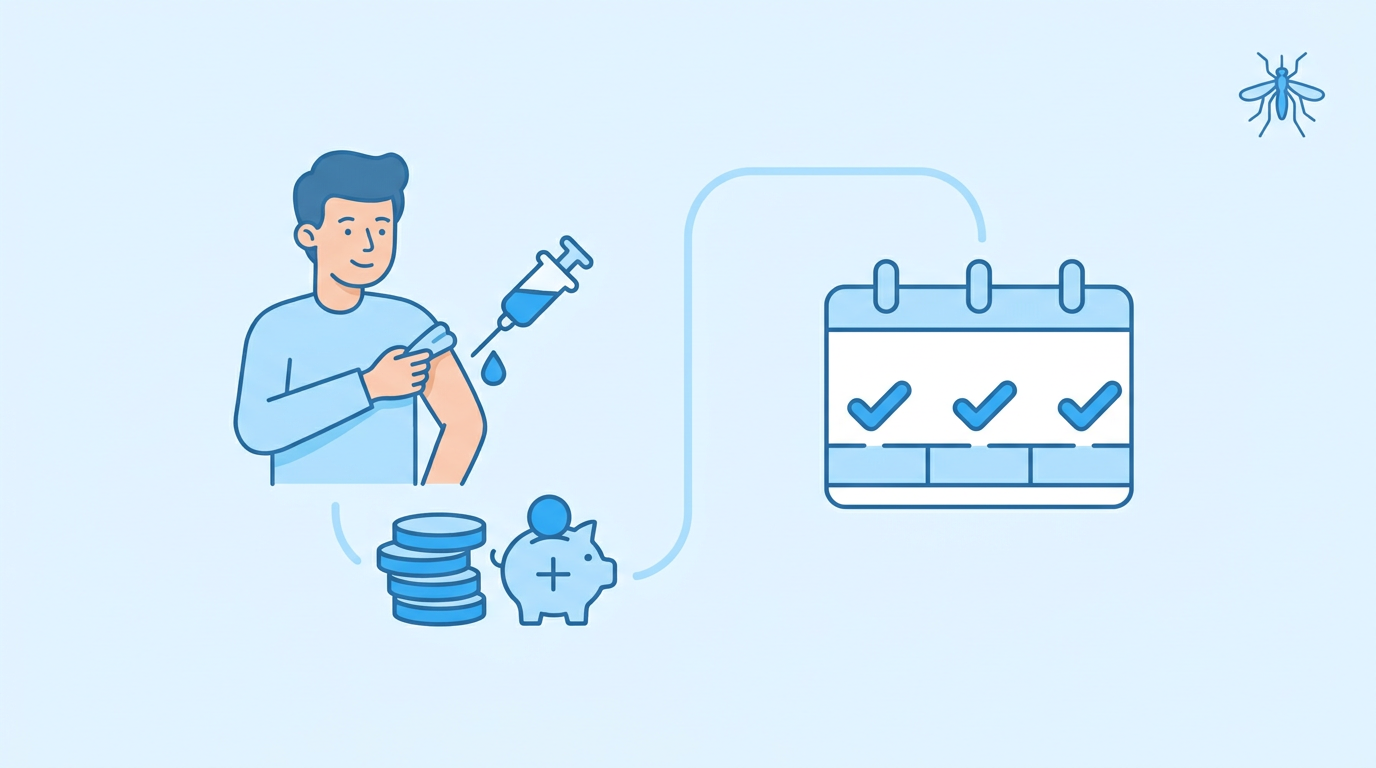
The Japanese encephalitis vaccine for adults in Korea costs roughly 40,000–55,000 KRW (about $29–$40 USD) per dose at private clinics, and it is not covered by the National Health Insurance (Korean public health insurance). Adults need 1 dose of the live attenuated vaccine (IMOJEV) or 3 doses of the inactivated vaccine. You can find a vaccination site near you through the KDCA’s National Immunization Program portal.
What is Japanese encephalitis, and why do adults need the vaccine?
Japanese encephalitis is an acute viral brain infection caused by the Japanese encephalitis virus (JEV), transmitted through the bite of an infected Culex tritaeniorhynchus mosquito.
Most infected people have no symptoms. When symptoms do appear, they can progress from fever and headache to severe brain inflammation. In cases that develop into full encephalitis, the fatality rate can reach 20–30%, and up to 30–50% of survivors may experience lasting neurological complications, according to the WHO.
So why does this matter for adults? Many Korean adults born before 1985, and most foreign residents or travelers, did not complete the current vaccination schedule. People who live or work near rice paddies, pig farms, or rural areas face a higher exposure risk — these environments are breeding grounds for the Culex mosquito. The KDCA recommends JE vaccination for adults in these situations, especially if they have no verifiable vaccination history.
✔ No antiviral treatment exists for JE — vaccination is the only effective prevention.
✔ Mosquito season in Korea: July through October.
✔ Highest-risk groups: rural residents, those near pig farms or rice paddies, travelers to JE-endemic countries.
✔ Source: KDCA, 2025; WHO Japanese Encephalitis fact sheet.
How much does the Japanese encephalitis vaccine cost for adults in Korea?
JE vaccination for adults is not covered by Korea’s National Health Insurance (건강보험, geongang bohum), so you pay out of pocket at private clinics. Prices vary by clinic and vaccine type.
As of 2026, the live attenuated vaccine IMOJEV costs approximately 40,000–55,000 KRW (about $29–$40 USD / approx. 200–280 CNY / 約4,400–6,000円) per dose at private clinics. The inactivated vaccine runs around 30,000–50,000 KRW per dose. Because adults need 3 doses of the inactivated vaccine, total costs can reach 90,000–150,000 KRW over roughly one year.
Public health centers (보건소, bogeonso — local government clinics operated by each district) may offer the vaccine at a reduced cost or, in some cases, free of charge, depending on stock availability. Policies differ by location, so call ahead before visiting.
If you hold a silson insurance policy (실손보험 — Korean private indemnity health insurance that reimburses out-of-pocket medical costs), check with your insurer directly to see whether preventive vaccination is covered under your plan.
| Vaccine Type | Example Product | Adult Doses | Cost per Dose (Clinic) |
|---|---|---|---|
| Live attenuated (live vaccine) | IMOJEV | 1 dose | ~40,000–55,000 KRW |
| Inactivated (killed virus) | Verorab, etc. | 3 doses | ~30,000–50,000 KRW |
Prices listed above are estimates and may vary by region and clinic. Use the Health Insurance Review and Assessment Service (HIRA) non-covered services database at hira.or.kr to compare prices at clinics near you before booking.
Where can adults get the Japanese encephalitis vaccine in Korea?
You can get vaccinated at local public health centers (보건소) or designated private clinics across Korea. The easiest way to find a nearby location is through the KDCA National Immunization Program (NIP) portal at nip.kdca.go.kr — search by region and select “Japanese encephalitis” to find clinics that carry the vaccine.
Note that not every clinic carries both vaccine types. If you prefer the live vaccine (IMOJEV) or the inactivated vaccine, call ahead to confirm stock before you visit. Public health centers are generally cheaper, but stock can run out during peak season (July–August).
✅ Visit nip.kdca.go.kr → search by region → select “Japanese encephalitis”
✅ Call ahead to confirm the specific vaccine (IMOJEV or inactivated) is in stock
✅ Ask the public health center whether free adult vaccination is available
✅ Compare clinic prices on the HIRA non-covered services site (hira.or.kr)
✅ Check with your private insurer about reimbursement eligibility
For more vaccination guides, visit the Korea Medical Information — Medications & Supplements category.
How many doses of the Japanese encephalitis vaccine do adults need?
The number of doses depends on which vaccine you choose.
IMOJEV, the live attenuated vaccine, requires just 1 dose for adults aged 18 and older who have no prior JE vaccination history. This makes it a convenient option for busy adults. The inactivated vaccine, on the other hand, requires 3 doses: the first dose, a second dose 1 month later, and a third dose 11 months after the second. Full primary immunization takes about a year.
One important rule: do not mix vaccine types. If you start with the live vaccine, finish with the live vaccine. The same applies to the inactivated vaccine. Switching between the two (cross-vaccination) is not recommended, according to both the KDCA and Seoul Asan Medical Center guidelines.
If you’re planning to travel to a JE-endemic country, start the vaccination series at least 4–6 weeks before departure — or ideally earlier if using the inactivated vaccine.
| Vaccine Type | Dose 1 | Dose 2 | Dose 3 |
|---|---|---|---|
| Live vaccine (IMOJEV) | Administer | Not required | Not required |
| Inactivated vaccine | Administer | 1 month after dose 1 | 11 months after dose 2 |
Do not switch between live and inactivated vaccines mid-series.
If your prior vaccination history is unclear, consult a doctor or your local public health center before starting.
Source: KDCA NIP portal; Seoul Asan Medical Center Drug Information FAQ.
Frequently Asked Questions
1. Do all adults in Korea need the Japanese encephalitis vaccine?
No — it’s not mandatory for every adult. The KDCA recommends it for adults who live near rice paddies or pig farms, plan to travel to JE-endemic countries, or have no verifiable vaccination history. Talk to a doctor to determine whether vaccination is right for you.
2. What side effects should I expect after the JE vaccine?
The most common reactions are injection-site pain, swelling, and redness. Some people experience mild fever, headache, or fatigue, which typically resolve within 2–3 days. Rare hypersensitivity reactions can occur. It’s recommended to stay at the clinic for 20–30 minutes after vaccination so medical staff can monitor you.
3. When is the best time of year to get vaccinated against Japanese encephalitis?
Aim to start vaccination before mosquito season (July–October) — ideally between April and June. If you’re using the 3-dose inactivated vaccine, plan at least a year in advance for full primary immunization.
4. If I was vaccinated as a child in Korea, do I need a booster as an adult?
If your childhood vaccination series was complete, you generally may not need additional doses as an adult. However, if your records are incomplete or unavailable, consult a doctor or public health center to assess your coverage.
5. Can pregnant women receive the Japanese encephalitis vaccine?
The live attenuated vaccine (IMOJEV) is generally not recommended during pregnancy. If you are pregnant and at high risk of JE exposure, speak with your OB-GYN before making any decision about vaccination.
References
- Korea Disease Control and Prevention Agency (KDCA), “Japanese Encephalitis (JE) Vaccination Guide,” 2025. Link
- IMOJEV Official Website, “What is IMOJEV?” (이모젭이란?), 2024. Link
- Seoul Asan Medical Center, “Can inactivated and live JE vaccines be given interchangeably?” Drug Information FAQ. Link
- Health Insurance Review and Assessment Service (HIRA), “Non-Covered Medical Services Price Information.” Link
- World Health Organization (WHO), “Japanese encephalitis vaccines — quality standards and norms.” Link
Leave a Reply