Table of Contents
After a full day at the beach or by the pool, it’s common to notice your shoulders and back turning red and hot by evening. Some people wake up the next morning with blisters and skin that stings at the slightest touch. Sunburn isn’t just a few uncomfortable days — treated the wrong way, it can lead to infection, scarring, or lasting dark spots. Knowing the right sunburn first aid steps in the first 24 hours makes a real difference in how quickly your skin recovers.
This guide walks through sunburn first aid step by step, based on guidance from Mayo Clinic, the American Academy of Dermatology, and Korea’s KDCA — how to cool the skin, when (and when not) to pop a blister, whether aloe vera actually helps, and the warning signs that mean it’s time to see a doctor.
What Is Sunburn and Why Does It Happen So Fast in Summer?
Sunburn is skin inflammation caused by overexposure to ultraviolet (UV) radiation, ranging from mild redness to painful blistering.
According to the CDC, UV rays are strongest between 10 a.m. and 4 p.m., and once the UV Index reaches 3 or higher, unprotected skin is at real risk.
Symptoms often don’t peak right away. Redness and pain can keep building for 24 to 72 hours after sun exposure, which is why sunburn frequently looks mild right after swimming and much worse the next morning.
UV rays peak between 10 a.m. and 4 p.m., and sunburn symptoms typically worsen for 24–72 hours after exposure — not immediately. (Source: CDC)
How Do I Give Sunburn First Aid at Home?
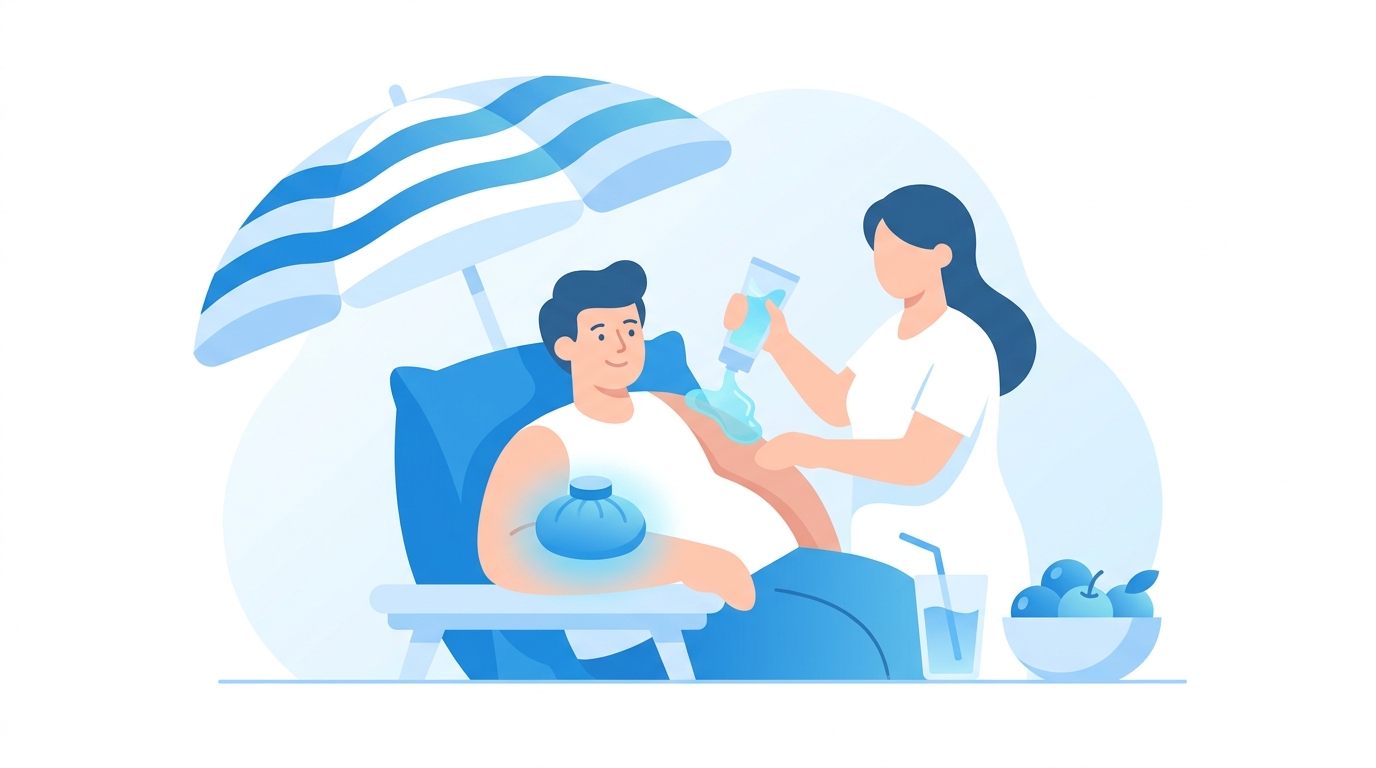
Cool the skin down, keep drinking water, and manage pain early — these three steps matter more than any specific product.
Mayo Clinic recommends cool showers or cool compresses for about 10 minutes, repeated several times a day. Pat your skin dry gently instead of rubbing it.
Sunburned skin pulls fluid toward the surface, so drink extra water for a day or two to avoid dehydration. Taking a nonprescription pain reliever such as ibuprofen or acetaminophen soon after overexposure can also help with swelling and discomfort (Mayo Clinic, AAD).
While your skin is still damp, apply a moisturizer containing aloe vera or soy (AAD). Skip products with alcohol, which dry the skin further, and be cautious with “-caine” anesthetic ingredients like benzocaine — there’s little solid evidence they help, and they can occasionally irritate skin.
✅ Cool water for 10 minutes, several times a day
✅ Extra water to prevent dehydration
✅ Ibuprofen or acetaminophen for pain
✅ Fragrance-free aloe vera moisturizer while skin is damp
✅ Avoid alcohol-based or “-caine” products
What Should I Do About Sunburn Blisters?
Leave blisters alone. Don’t pop them yourself — an intact blister is your skin’s own protective barrier against infection.
A blister forming after sun exposure is a sign of second-degree sunburn, meaning deeper skin layers were damaged, not just the surface (AAD). Popping it on purpose only raises your infection risk.
| Type | First-degree (mild) | Second-degree (with blisters) |
|---|---|---|
| Skin appearance | Redness, warmth | Blisters, oozing, severe pain |
| Self-care | Cool compress, moisturizer, pain reliever | Protect blisters, prevent infection |
| See a doctor? | Usually not needed | Recommended if large, on the face, or over a joint |
If a blister breaks on its own, gently rinse the area with saline, pat dry, apply a thin layer of petroleum jelly, and cover it with a clean, non-stick bandage (AAD). Change the dressing daily and watch for signs of infection like pus or spreading redness.
Never puncture a blister with a needle, even a sterilized one. This home remedy raises infection risk instead of speeding healing.
Does Aloe Vera Really Help, and When Should I See a Doctor?
Aloe vera gel can feel soothing and help keep skin moisturized, but current evidence doesn’t clearly show it speeds up sunburn healing (Cleveland Clinic).
Chilling the gel in the refrigerator before applying adds a cooling effect that many people find comforting (Mayo Clinic). Choose a fragrance-free, alcohol-free product to lower the chance of irritation.
For mild to moderate sunburn, some clinicians suggest an over-the-counter 1% hydrocortisone cream applied three times a day for a few days — but check with a pharmacist or doctor first, especially over broken skin or a large area (Mayo Clinic).
If you’re seeing a dermatologist while in Korea, basic outpatient visits are covered under National Health Insurance (NHI, Korea’s public health insurance system available to residents and many visiting foreigners), so a first visit typically isn’t expensive.
Aloe vera is a soothing, moisturizing aid — not a treatment. If pain or blistering is severe, a clinic visit matters more than home remedies.
✅ High fever, chills, or nausea
✅ Pus or increasing swelling around a blister
✅ Blisters covering a large area, the face, a joint, or genitals
✅ Sunburn in an infant or young child (per AAD)
You can find more summer skin condition guides in our Disease Encyclopedia category. (Internal link: recommend replacing once a related article is published)
Frequently Asked Questions
1. How long does sunburn usually take to heal?
Mild sunburn often fades within three to seven days. Sunburn with blistering can take one to two weeks or longer, and peeling skin is a normal part of that process.
2. Is it okay to pop a sunburn blister?
It’s better not to. The blister’s covering protects the raw skin underneath from bacteria. If it bursts on its own, clean it gently and cover it with a sterile, non-stick dressing.
3. Can I use aloe vera gel every day?
Generally yes, if your skin isn’t reacting badly to it. Look for a fragrance-free, alcohol-free formula, since added ingredients can sometimes irritate already sensitive, sunburned skin.
4. Is it normal for skin to peel after a sunburn?
Yes — peeling is usually just your body shedding damaged surface cells. Avoid picking at peeling skin, since that can increase the risk of scarring or uneven pigmentation; keep the area moisturized instead.
References
Mayo Clinic, “Sunburn: First aid.” Link
American Academy of Dermatology, “How to Treat Sunburn.” Link
CDC, “Preventing Sunburn.” Link
Cleveland Clinic, “Is Aloe Vera Good for Sunburn?” Link
Korea Disease Control and Prevention Agency (KDCA), “일광화상 (Sunburn),” National Health Information Portal. Link
This article is for general informational purposes only and is not a substitute for professional medical advice, diagnosis, or treatment. Please consult a qualified healthcare provider if you have health concerns.
Leave a Reply