Table of Contents
Korea’s health authorities lifted the official COVID-19 “watch” alert on July 7, 2026, after 2,378 days of monitoring. That sounds like good news — but it’s not the full picture.
Experts have flagged a once-dormant variant lineage making a comeback, and officials are still watching closely for a summer resurgence. If you’ve pulled an old self-test kit out of a drawer, you might be fuzzy on the exact steps.
This guide walks you through how to use a COVID-19 self-test kit in four steps, explains how accurate rapid antigen tests really are, and covers what to do if your result comes back positive or unclear.
Is COVID-19 spreading again this summer?
Not a nationwide surge yet, but health authorities are closely watching signs of a possible summer resurgence.
A COVID-19 resurgence means case and hospitalization numbers turn upward again after a period of decline. The Korea Disease Control and Prevention Agency (KDCA), Korea’s equivalent of the CDC, lifted its “watch” alert level on July 7, 2026, after 2,378 days. That’s a lower crisis level — it doesn’t mean the virus is gone.
Some infectious disease specialists have pointed out that a variant lineage that stayed quiet for years is spreading again. Health authorities have also kept holding response meetings to monitor summer resurgence signs.
The official crisis level dropped, but variant activity and summer resurgence risk are still being watched. If you have symptoms, testing yourself with a COVID-19 self-test kit first is a smart habit.
How do I use a COVID-19 self-test kit?
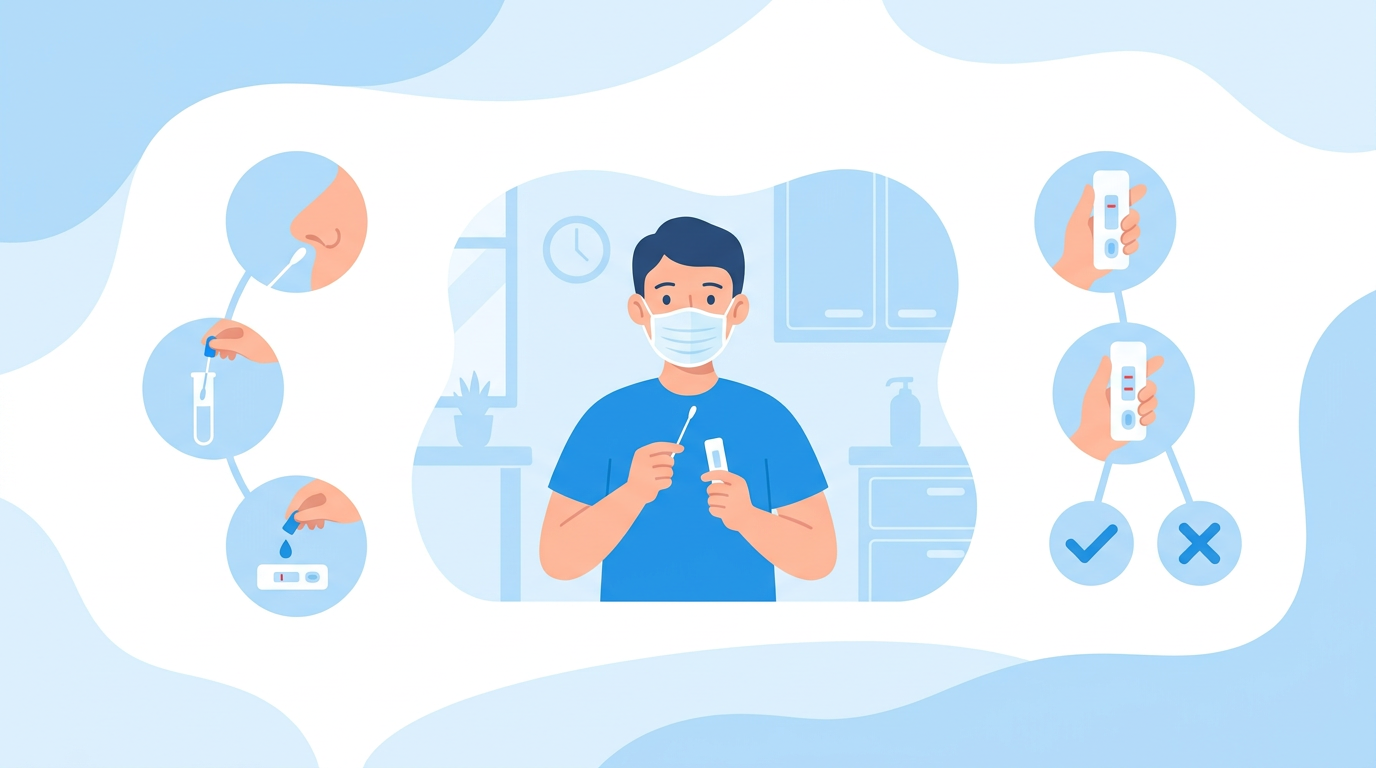
Wash your hands, swab your nose, mix the sample, and read the result after about 15 minutes.
A COVID-19 self-test kit is an at-home tool that detects viral proteins (antigens) in a nasal sample, giving you a quick first read on infection. You don’t need medical training — just 15 minutes.
| Step | What to do |
|---|---|
| ① Prepare | Wash your hands and test in a well-ventilated space. |
| ② Swab | Insert the swab about 1.5–2cm into each nostril and rotate it roughly 10 times. |
| ③ Mix | Swirl the swab in the solution tube 10+ times, then squeeze it out and remove it. |
| ④ Read | Check after about 15 minutes. One line means negative; two lines means positive. |
Avoid blowing your nose or touching inside your nostrils for at least 15 minutes before testing. Unlike tests done at a screening clinic (a public COVID-19 testing site run by Korean local health authorities), a self-test’s accuracy depends heavily on how well you swab.
✅ Don’t touch or blow your nose for 15 minutes before testing
✅ Check the package for regulatory approval (in Korea, MFDS-approved products)
✅ Don’t use a kit past its expiration date
✅ Seal and dispose of the used swab and tube properly
Source: Korea’s Ministry of Food and Drug Safety (MFDS) and Seoul Metropolitan Government, “Correct Use and Guidelines for COVID-19 Self-Test Kits.”
How accurate is a rapid antigen test?
Specificity is over 99%, but sensitivity ranges from about 71% to 87% depending on your symptoms and test timing.
Sensitivity is how well a test catches a true infection; specificity is how well it correctly rules one out. A meta-analysis published in Clinical Microbiology and Infection found that FDA-authorized rapid antigen tests had an average sensitivity of 84.5% and specificity of 99.6%.
| Category | Sensitivity |
|---|---|
| With symptoms | About 87% |
| Without symptoms | About 71% |
| FDA-authorized average (2025 meta-analysis) | About 84.5% |
A self-collected swab tends to be less accurate than one taken by a trained professional. Early in an infection, viral load can be too low to detect, so a negative result doesn’t always rule out COVID-19.
Source: Clinical Microbiology and Infection (ScienceDirect) meta-analysis, 2025; systematic review, PMC.
What should I do if my result is positive or unclear?
Treat even a faint second line as positive. Retest after 48 hours or get a PCR test at a screening clinic if you need confirmation.
The U.S. FDA and CDC recommend serial testing: two tests 48 hours apart if you have symptoms, or three tests 48 hours apart if you don’t. A single negative result isn’t enough to fully rule out infection — repeat testing raises accuracy.
If your self-test comes back positive, visiting a nearby screening clinic or clinic for a confirmatory PCR test is the safest next step. If you’re in a high-risk group — older adults or people with underlying conditions — talk to a doctor promptly, even with mild symptoms.
The methods and figures in this article are general information and can’t replace an individual diagnosis or treatment plan. Get an accurate diagnosis from a healthcare provider.
For more exam and procedure guides, visit our Exams & Procedures Guide category. (Internal link: to be replaced once a related article is published)
Frequently Asked Questions
1. I have symptoms but my first test was negative — what now?
Retest after 48 hours. Early in an infection, viral load can be too low to detect, so a true infection can still show a negative result at first.
2. When should an asymptomatic close contact get tested?
Testing once right after exposure isn’t as reliable as testing again a few days later. If you’ve been exposed, consider repeat testing even without symptoms.
3. Where can I buy a COVID-19 self-test kit?
You can buy one at pharmacies and convenience stores. Check that the product is officially approved (MFDS-approved in Korea) and not expired.
4. If my self-test is positive, do I have to see a doctor?
If you’re in a high-risk group or have severe symptoms, seeing a healthcare provider is the safer choice. Get a confirmatory PCR test at a screening clinic if needed.
References
(Korea Disease Control and Prevention Agency, KDCA), “Press Release on COVID-19 Crisis Level Adjustment,” 2026. Link
(Seoul Metropolitan Government / Ministry of Food and Drug Safety), “Correct Use and Guidelines for COVID-19 Self-Test Kits.” Link
(Medical News/의학신문), “KDCA Closely Monitoring Summer COVID-19 Resurgence,” 2026. Link
(Clinical Microbiology and Infection), “Preapproval and postapproval diagnostic test accuracy of FDA-authorized rapid antigen SARS-CoV-2 tests,” 2025. Link
(U.S. Centers for Disease Control and Prevention, CDC), “Testing for COVID-19.” Link
(Mayo Clinic News Network), “Types of COVID-19 tests and when to use them.” Link
This article is for general informational purposes only and is not a substitute for professional medical advice, diagnosis, or treatment. Please consult a qualified healthcare provider if you have health concerns.
Leave a Reply