
Table of Contents
On June 22, 2026, Korea’s disease control agency issued a nationwide malaria warning. Mosquito index levels crossed the threshold not just near the border but in Guro-gu, Seoul.
If you thought malaria was only a border-region problem, it’s time to double-check. Repeated fever and chills might not be a simple cold.
This article covers why Korea’s 2026 malaria warning was issued, the key malaria symptoms Korea residents should watch for, mosquito habitats, and the incubation period behind delayed fevers, based on KDCA data. You’ll also find risk areas and prevention tips.
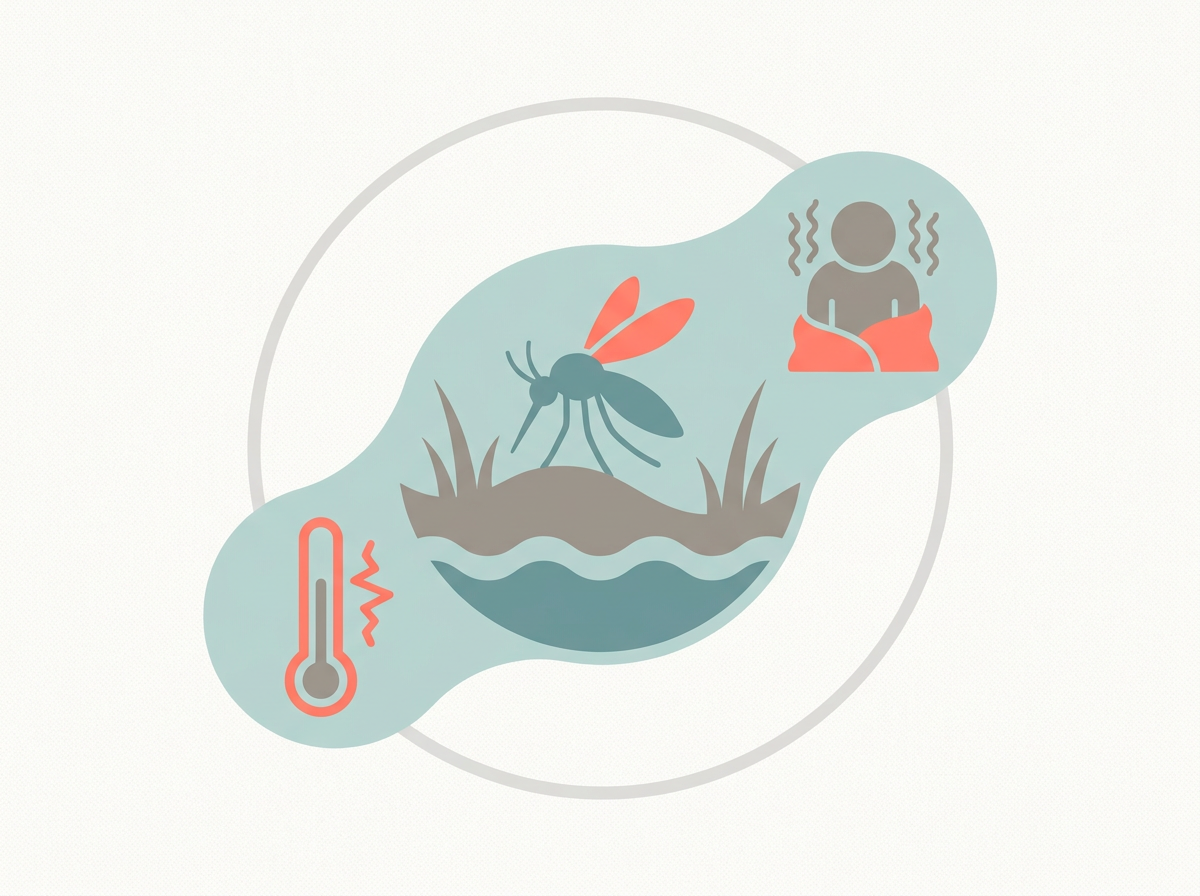
Why was Korea’s malaria warning issued now?
The Korea Disease Control and Prevention Agency (KDCA) issued the nationwide warning on June 22, 2026, after Anopheles mosquito density crossed the alert threshold.
A malaria warning is declared when three or more cities or counties record a mosquito Trap Index (TI) of 0.5 or higher. In week 24 of 2026, Paju (0.8), Ganghwa (1.0), Yanggu (0.7), and Guro-gu (0.5) all met that bar.
Through week 24 (Jan. 1–June 13), Korea recorded 74 domestic cases, down 45.6% from 136 in the same period last year. Still, cases keep appearing, mostly in Gyeonggi (58.1%), Incheon (23.0%), and Seoul (10.8%).
Warning threshold: mosquito index 0.5+ in 3 or more areas
2026 warning areas: Paju, Ganghwa, Yanggu, Guro-gu
2026 cases: 74 (down 45.6% year-over-year)
Source: KDCA (Korea Disease Control and Prevention Agency), “Nationwide Malaria Warning Issued,” 2026.
What are the malaria symptoms Korea residents should recognize?
The clearest sign is a recurring cycle of fever, chills, and sweating — a pattern that sets it apart from an ordinary cold.
Malaria symptoms are fever, chills, sweating, headache, muscle pain, nausea, vomiting, and diarrhea that recur in cycles.
Most Korean cases involve vivax malaria, which often follows a pattern of fever one day, none the next, then fever again the day after. Early on, it’s easy to mistake for a bad case of the flu, which can delay diagnosis.
Main symptoms: fever, chills, sweating, headache, muscle pain, nausea, vomiting, diarrhea
Vivax malaria pattern: fever recurs every other day
If fever develops after visiting a risk area, see a doctor or public health center right away and mention your travel history.
Where do malaria-carrying mosquitoes live in Korea?
Malaria mosquito habitats are standing-water spots — rice paddies, irrigation channels, and puddles — where larvae develop.
Anopheles mosquitoes are medium-sized mosquitoes with black-and-white speckled wings that rest with their abdomen tilted upward at 40–50 degrees.
Adults feed mostly at night, often on cattle, horses, and pigs, then rest in grass near livestock sheds. That’s why border-adjacent areas like Paju, Ganghwa, Yeoncheon, Cheorwon, and Yanggu — rich in this kind of habitat — report the most cases.
✅ Black-and-white speckled wings
✅ Rests with abdomen tilted upward
✅ Common near paddies, channels, puddles, and livestock sheds
✅ Most active from dusk to dawn
How long is the malaria incubation period before fever starts?
The malaria incubation period can be as short as 12–17 days, but in some cases the first fever doesn’t appear until the following year.
The incubation period is the stretch between a mosquito bite and the first symptoms. Vivax malaria in Korea shows both a short form (about 15 days on average) and a long form (6–12 months).
That means you could be bitten this summer and not run a fever until the next one. Because of this, always mention any visit to a risk area when seeing a doctor, no matter how long ago it was.
Short incubation: 12–17 days (about 15 on average)
Long incubation: 6–12 months, sometimes the following year
✅ Avoid outdoor activity from dusk to dawn
✅ Wear light-colored, long clothing
✅ Use mosquito repellent
✅ Repair screens and use bed nets
✅ Use indoor insecticide
Frequently Asked Questions
1. Am I safe if I don’t live in a risk area like Paju or Ganghwa?
Not necessarily. If you’ve visited a risk area or spent evenings outdoors nearby, you’re still at some risk. Guro-gu, a non-border district in Seoul, is also under the current warning.
2. Is malaria in Korea as dangerous as malaria abroad?
Domestic cases are almost always vivax malaria, which tends to be milder than falciparum malaria found in tropical regions. Even so, delayed treatment can lead to complications, so early care matters.
3. How long should I watch for symptoms after a mosquito bite?
Short-incubation cases show up within 2–3 weeks, but Korea’s vivax malaria can also have a long incubation period, so it’s worth staying alert to fever for up to a year.
4. Is there a vaccine or preventive drug for malaria in Korea?
There’s no routine vaccination for Korea’s domestic risk areas. Physical prevention — repellent, screens, and bed nets — is the main defense. If you’re traveling to a high-risk region abroad, ask your doctor or pharmacist about preventive medication.
5. What tests will a doctor run to check for malaria?
Doctors typically order a blood smear test under a microscope, a rapid antigen test, or a PCR test if needed. Mentioning your travel or residence history in a risk area helps speed up diagnosis.
References
Korea.kr Policy Briefing, “Nationwide Malaria Warning Issued” (전국 말라리아 주의보 발령), 2026. Link
KDCA, “Malaria Infection Control” (말라리아감염병관리). Link
World Health Organization (WHO), “Malaria” Fact Sheet, 2025. Link
Mayo Clinic, “Malaria – Symptoms and causes.” Link
Note: Korea’s national health insurance (a mandatory public health coverage system all residents pay into) covers malaria testing and treatment at Korean hospitals and clinics.
For more disease information, visit the Disease Encyclopedia category. (Internal link: recommend replacing once a related article is published)
This article is for general informational purposes only and is not a substitute for professional medical advice, diagnosis, or treatment. Please consult a qualified healthcare provider if you have health concerns.
Leave a Reply