Table of Contents
In May 2026, the World Health Organization declared the Ebola outbreak in the Democratic Republic of the Congo and Uganda a Public Health Emergency of International Concern.
The outbreak topped 1,000 confirmed cases within just 40 days of the response starting, making it one of the fastest-growing Ebola outbreaks on record. If you’re planning travel to Africa, it’s worth knowing the Ebola incubation period, key symptoms, and how to report a fever after you return.
Ebola incubation period symptoms typically start 8 to 10 days after exposure, though the range runs from 2 to 21 days. Early symptoms feel flu-like — fever and body aches — but can progress to vomiting and diarrhea as the illness advances.
Here’s what you need to know about incubation, symptoms, current outbreak countries, and fever-reporting steps.
Ebola Incubation Period Symptoms: When Do They Start?
Symptoms usually begin 8 to 10 days after exposure, with a possible range of 2 to 21 days.
Ebola disease is an acute, severe illness caused by infection with an orthoebolavirus. The virus first jumps to humans from infected wild animals, such as fruit bats, then spreads person-to-person through direct contact with an infected person’s blood or body fluids, or with contaminated surfaces.
| Incubation stage | Duration |
| Shortest | 2 days |
| Average | 8-10 days |
| Longest | 21 days |
You’re not contagious during the incubation period. A person can only spread Ebola after symptoms appear.
Source: CDC, “Ebola Disease Basics,” 2026 / WHO, “Ebola disease” Fact Sheet, 2026
What’s the Difference Between Early and Late Ebola Symptoms?
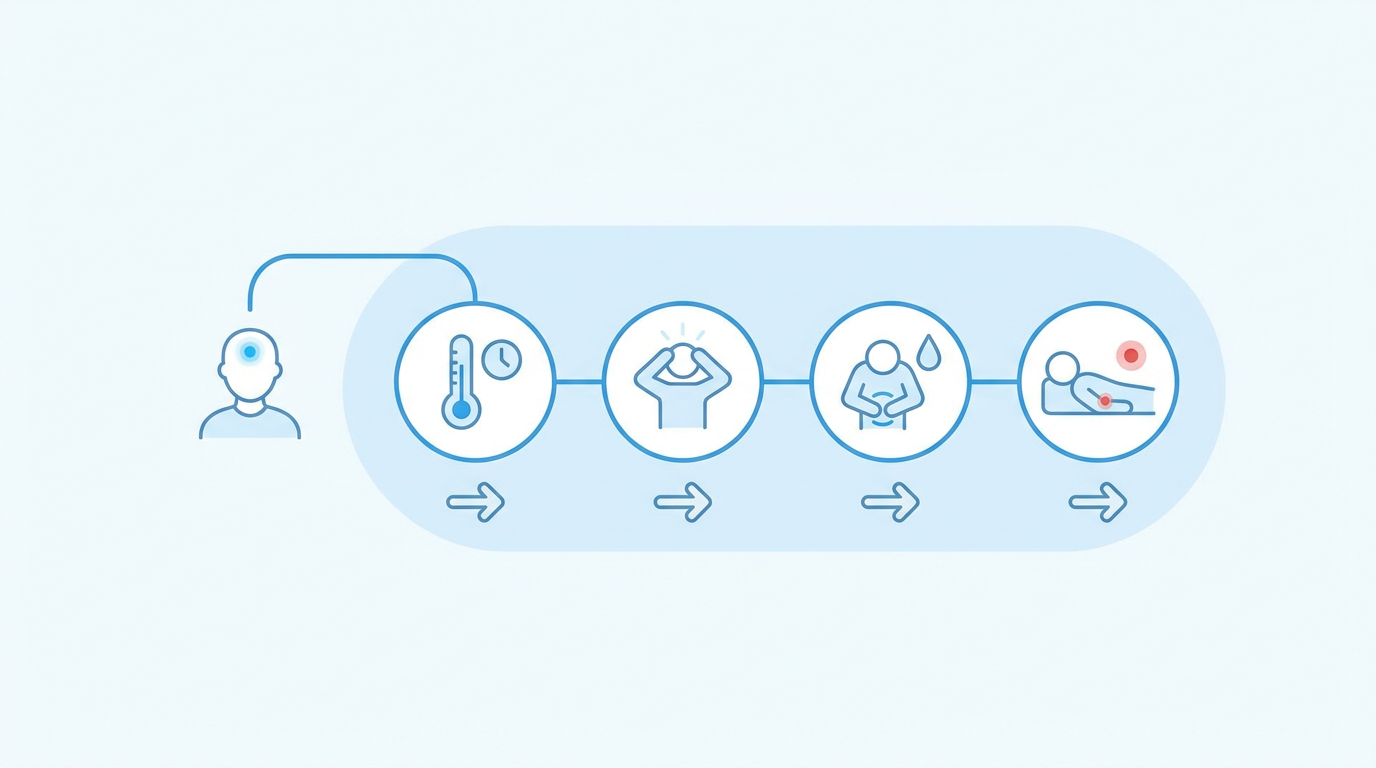
Early Ebola symptoms look like a bad flu — fever, aches, and fatigue — while symptoms after day 4 or 5 can include vomiting, diarrhea, and, in rare cases, unexplained bleeding.
Symptoms can worsen quickly, so if you have a fever and recently traveled to an affected area, don’t wait to seek care.
Early symptoms (days 1-3)
1. Sudden fever (100.4°F / 38°C or higher)
2. Severe fatigue and muscle aches
3. Headache and sore throat
Later symptoms (day 4-5 onward)
1. Severe vomiting and diarrhea
2. Abdominal pain
3. Unexplained bleeding (gums, rash, etc.)
✅ Fever of 100.4°F (38°C) or higher
✅ Severe fatigue or muscle aches
✅ Vomiting or diarrhea
✅ Unexplained bleeding
Source: CDC, “Clinical Features of Ebola Disease,” 2026
Which Countries Have Ebola Outbreaks, and Why Is Quarantine Tighter?
The current outbreak is centered in the Democratic Republic of the Congo, and South Korea’s disease control agency has designated five countries — the DRC, Uganda, South Sudan, Ethiopia, and Rwanda — as priority quarantine zones with tighter screening.
WHO declared this outbreak, caused by the Bundibugyo virus species, a global emergency on May 17, 2026. Uganda declared its own outbreak over on July 28, but the DRC still has active transmission across 49 of 140 health zones in five provinces.
| Priority quarantine countries | Designated |
| DRC, Uganda, South Sudan | May 19, 2026 |
| Ethiopia, Rwanda | May 26, 2026 |
Since only Ethiopia has direct flights to Korea, travelers from the other four countries usually connect through a third country — and are still subject to screening.
Source: Korea Disease Control and Prevention Agency (KDCA) press release, 2026 / WHO Disease Outbreak News, 2026
What Should You Do If You Have a Fever After Traveling to Africa?
If you visited a priority quarantine country, you must report your health status at the airport using Q-CODE (a mobile health declaration) or a paper health questionnaire, then self-monitor for 21 days — calling 1339 (Korea’s disease hotline) or your local public health center right away if fever or abdominal pain appears.
Even if you missed reporting at the airport, calling in as soon as symptoms show up is what actually limits spread.
1. Declare your travel history and health status to a quarantine officer on arrival
2. Self-monitor your temperature and symptoms for 21 days
3. Call 1339 or your local health center immediately if fever, abdominal pain, or vomiting appears
4. Always mention your travel history before visiting a clinic in person
Call 1339 first instead of walking straight into a clinic — this protects other patients and healthcare workers from potential exposure.
For more infectious disease information, visit the Disease Encyclopedia category on Korea Medical Info. (Internal link: recommend replacing once a related article is published)
Source: KDCA press release, 2026
Frequently Asked Questions
1. Is Ebola airborne?
No. Unlike flu, Ebola doesn’t spread through the air. It spreads mainly through direct contact with an infected person’s blood or body fluids, or contaminated objects.
2. Can you spread Ebola during the incubation period?
No. A person isn’t considered contagious until symptoms appear, so the risk starts once symptoms — not exposure — begin.
3. Is there a vaccine or treatment for Ebola?
There’s currently no approved vaccine or targeted treatment for the Bundibugyo virus species driving this outbreak. Early hospital care and supportive treatment may improve survival odds. Always discuss specific treatment options with a doctor.
4. Do I need a vaccination before traveling to Africa?
There’s no commercial vaccine against the current outbreak strain. Check the latest travel advisories and precautions with a travel clinic or quarantine station before you go.
5. Is the risk of Ebola infection high in Korea?
Current risk in Korea is assessed as low. Still, anyone who has visited a priority quarantine country must follow the reporting requirements.
References
Korea Disease Control and Prevention Agency (KDCA), “Ebola Outbreak Region Quarantine Strengthened” (에볼라 유행지역 검역 관리 강화), 2026. Link
WHO, “Ebola disease” Fact Sheet, 2026. Link
CDC, “Ebola Disease Basics,” 2026. Link
WHO, “Ebola disease caused by Bundibugyo virus, DRC & Uganda,” Disease Outbreak News, 2026. Link
This article is for general informational purposes only and is not a substitute for professional medical advice, diagnosis, or treatment. Please consult a qualified healthcare provider if you have health concerns.
Leave a Reply