Table of Contents
Every summer, daycare centers and kindergartens face the same challenge: hand, foot, and mouth disease spreading fast through groups of young children. Recognizing hand foot mouth disease symptoms early — such as sudden fever, blister-like rash on the hands and feet, and painful mouth sores — helps you act fast and limit spread. If your child shows these signs, you need clear answers quickly.
Hand, foot, and mouth disease (HFMD) is a highly contagious viral illness caused by enteroviruses — most often coxsackievirus A16. It mainly affects children under 5. No vaccine or specific antiviral exists in Korea, Japan, or the US. The virus is most contagious in the first 7 days. Thorough handwashing and keeping sick children home are the most effective prevention strategies available.

What Is Hand, Foot, and Mouth Disease?
Hand, foot, and mouth disease (HFMD) is an acute viral infection caused by enteroviruses — particularly coxsackievirus A16, coxsackievirus A6, and enterovirus A71 (EV-A71) — that produces blister-like sores inside the mouth and a rash on the hands and feet.
HFMD is one of the most common childhood infections across East and Southeast Asia. In Korea, peak season runs from May through July, with outbreaks frequently reported in daycare centers and preschools. The 2025 Korea Disease Control and Prevention Agency (KDCA) guidelines note that while HFMD is not a legally notifiable disease, mass outbreaks should be reported to local public health centers to limit spread.
Adults can also get HFMD — usually with mild or no symptoms. However, they can still transmit the virus to young children, often without realizing it. This silent spread is one reason HFMD is difficult to contain once it enters a group setting.
• Coxsackievirus A16 — most common cause of hand, foot, and mouth disease worldwide
• Coxsackievirus A6 — associated with a more widespread rash
• Enterovirus A71 (EV-A71) — linked to rare but serious neurological complications, especially in infants
Hand Foot Mouth Disease Symptoms: What to Expect
Hand foot mouth disease symptoms follow a predictable pattern, with an incubation period of 3 to 6 days. Most children recover within 7 to 10 days without specific treatment.
In the first 1 to 2 days, your child may develop a fever — typically 38 to 39°C (100 to 102°F) — along with sore throat, reduced appetite, and general tiredness. Then, small red spots, about 2 to 5 mm in size, appear inside the mouth on the tongue, gums, and inner cheeks. These quickly turn into painful ulcers that make eating and drinking difficult.
Around the same time, a similar blister-like rash appears on the palms and soles of the feet. In some children, it spreads to the buttocks or knees. The blisters are usually more painful than itchy.
The biggest risk during HFMD is dehydration. Because mouth sores make swallowing painful, children often refuse to eat or drink. Keeping your child hydrated is the single most important thing you can do at home.
✅ Fever (38°C / 100°F or higher) in the first 1–2 days
✅ Painful mouth ulcers — child refuses food or drinks
✅ Blister-like rash on palms and soles of feet (2–5 mm)
✅ Possible rash on buttocks, knees, or genitals
✅ Excessive drooling in infants and toddlers
✅ Seek immediate care if: fever lasts more than 2 days, persistent vomiting, limb weakness, or seizures occur
In rare cases, HFMD can lead to encephalitis, myocarditis, or pulmonary edema. EV-A71 is most often linked to these severe outcomes, particularly in infants under 1 year. Go to the emergency room immediately if your child shows high fever lasting more than 2 days, repeated vomiting, unusual drowsiness, limb weakness, or seizures.
Source: Seoul National University Hospital Health Information, 2023
How Does Hand, Foot, and Mouth Disease Spread?
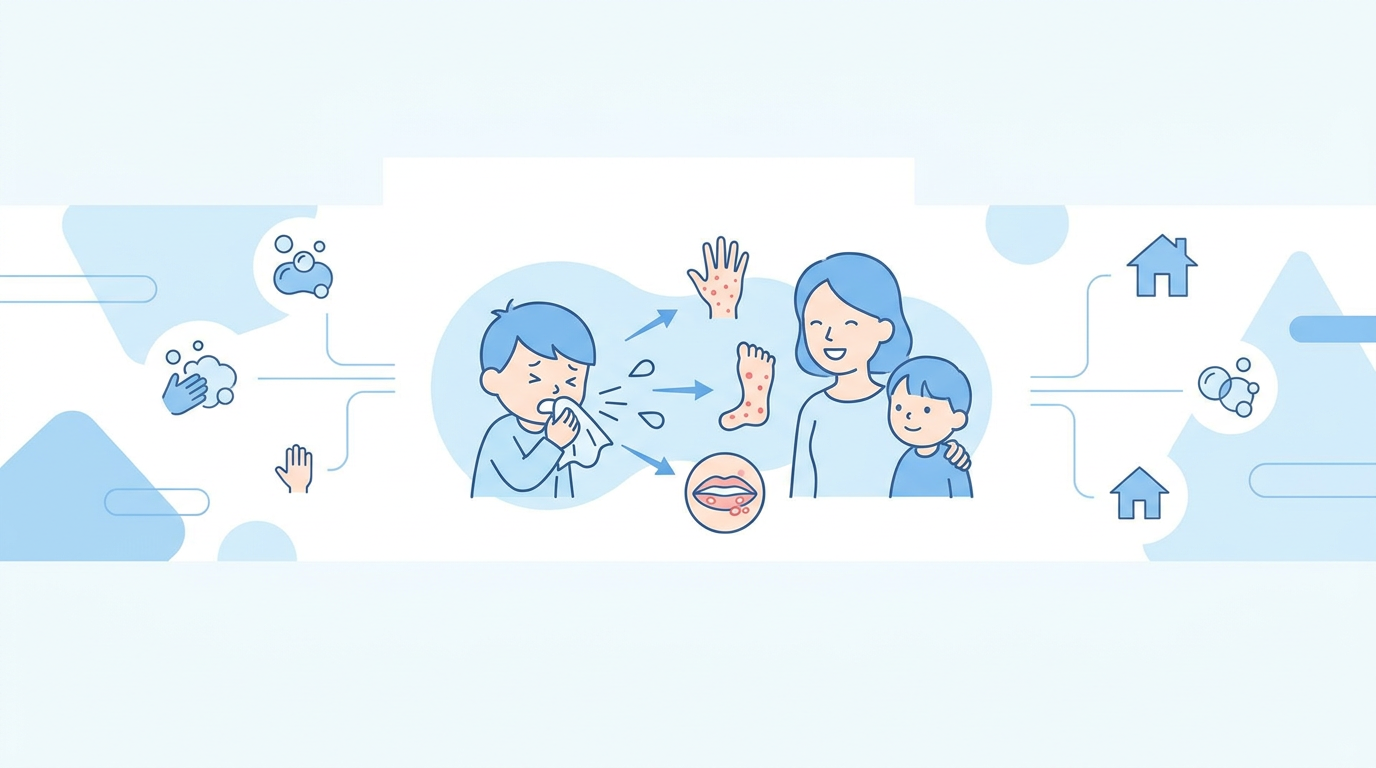
Hand, foot, and mouth disease spreads easily — through three main routes. Understanding them helps you protect your child and limit spread to others.
Route 1 — Droplet transmission: Coughing and sneezing release virus-containing droplets. Anyone nearby can inhale them.
Route 2 — Direct contact: Touching an infected person’s saliva, nasal discharge, blister fluid, or stool — then touching your mouth — can transmit the virus. Shared toys, door handles, and utensils are common vehicles.
Route 3 — Fecal-oral route: The virus is shed in stool for several weeks after symptoms resolve. Proper diaper disposal and careful handwashing after diaper changes are critically important, even after your child looks and feels better.
People with no symptoms — including parents and older siblings — can carry and spread the virus. This is why HFMD is so hard to contain in daycare settings. The virus is most contagious during the first week of illness, but viral shedding can continue for weeks after recovery.
Source: CDC Yellow Book 2024, Hand, Foot, and Mouth Disease
🧼 Handwashing tips: Wash with soap and running water for at least 20 to 30 seconds. Scrub between fingers, backs of hands, and wrists. Regularly disinfect frequently touched objects — toys, doorknobs, shared utensils.
Browse the Disease Encyclopedia
How Long Should a Child Stay Home With Hand, Foot, and Mouth Disease?
The 2025 KDCA guidelines recommend keeping children home from daycare or school while they have active symptoms. There is no legally mandated isolation period in Korea.
The general guidance is to wait until the fever has resolved and mouth sores and hand/foot blisters have dried — typically 7 to 10 days after symptoms begin. Check with your child’s specific facility, as individual daycare centers or preschools may require a doctor’s clearance note before the child returns.
If you are in Korea and your child attends a daycare covered under Korean national health insurance (건강보험, geongang-boheo), the pediatric clinic visit for assessment and treatment may be partially covered. Always confirm with your insurer or facility.
✅ Fever-free for at least 24 hours without fever-reducing medication
✅ Mouth ulcers have healed enough to eat and drink normally
✅ Blisters on hands and feet have dried or crusted over
✅ Child’s overall energy and appetite have returned to normal
✅ Doctor has confirmed it is safe to return (if required by your facility)
① Use separate towels, cups, and utensils for the sick child.
② Wash hands immediately and thoroughly after every diaper change.
③ Disinfect toys and frequently touched surfaces daily.
④ Avoid public pools and communal bathing facilities while symptoms are present.
Frequently Asked Questions
Q1. Can hand foot mouth disease symptoms be treated with specific medication?
No antiviral medication is approved for HFMD. Treatment is supportive: fever reducers for high temperature, pain relievers for mouth sores, and consistent hydration. If your child’s symptoms worsen or they refuse all fluids, consult a doctor promptly.
Q2. How long is HFMD contagious?
HFMD is most contagious during the first week of illness. However, the virus can be detected in stool for several weeks after recovery. A person can spread HFMD without showing any symptoms — which is why thorough handwashing matters even after your child appears well.
Q3. Can adults get hand, foot, and mouth disease?
Yes. Adults can get HFMD, usually with mild or no symptoms. Without knowing they are infected, adults can pass the virus to young children. Parents and caregivers should wash their hands frequently, especially when caring for a sick child or changing diapers.
Q4. What is the difference between HFMD and herpangina?
Both are caused by enteroviruses and involve mouth sores. The key difference is location: herpangina causes ulcers only at the back of the throat, while HFMD also produces blisters on the hands and feet. A pediatrician can help distinguish between the two.
Q5. Is there a vaccine for hand, foot, and mouth disease?
No HFMD vaccine is currently approved in Korea, the US, or Japan. China has approved a vaccine targeting EV-A71 specifically — but it does not cover the other virus strains that cause HFMD. Consistent handwashing and keeping sick children home remain the most effective prevention strategies available.
References
- Korea Disease Control and Prevention Agency (KDCA), “2025 Management Guidelines for Enterovirus Infections and Hand, Foot, and Mouth Disease” (2025년도 엔테로바이러스감염증·수족구병 관리지침), 2025. Link
- Seoul National University Hospital, “Hand, Foot, and Mouth Disease” (수족구병 건강정보). Link
- Centers for Disease Control and Prevention (CDC), “Hand, Foot and Mouth Disease,” CDC Yellow Book 2024. Link
- Pan American Health Organization (PAHO), “Epidemiological Alert: Hand, Foot, and Mouth Disease,” March 2025. Link
- Korean Pediatric Society, “Disease Information: Hand, Foot, and Mouth Disease” (수족구병 질환 정보). Link
Leave a Reply