Table of Contents
Most of us have tossed and turned through at least one sticky, sleepless summer night. But tropical-night insomnia may not stop at next-day fatigue.
If your knees or shoulders feel unusually stiff after a rough night’s sleep, sleep deprivation and joint pain may be more closely linked than you think, especially during Korea’s hot, humid tropical nights.
This article explains why sleep deprivation and joint pain tend to show up together, how poor sleep weakens your immune system, and which sleep positions and bedroom habits actually help during tropical-night heat. The key takeaway: protecting your sleep quality is one of the most effective ways to manage nighttime joint pain.
Sleep Deprivation and Joint Pain: Why Do They Show Up Together on Hot Nights?
Losing sleep lowers your pain threshold, so joint sensations that would normally feel minor start to feel much more painful. Your joints haven’t necessarily gotten worse overnight. Your brain and nervous system have simply become more sensitive to pain signals.
This link between sleep deprivation and joint pain shows up in real clinical settings, too. In one hospital survey, more than 60% of patients seeking treatment for joint pain also reported sleep problems, and about 62% said their pain worsened during tropical nights.
When you don’t get enough sleep, the brain’s ability to regulate pain signals weakens. The same stimulus feels stronger, and your body’s natural pain-inhibiting system works less effectively. Research on healthy adults found that even one night of total sleep deprivation noticeably raised sensitivity to pressure and cold pain.
Sleep loss doesn’t usually create brand-new joint inflammation. Instead, it makes your brain register existing pain and stiffness more intensely. That’s why people with pre-existing knee or shoulder issues often notice their pain spike after just a few tropical nights in a row.
Source: Sisa Journal, “Tropical Nights Make Sleepless Joints Hurt More” / NIH, research on sleep deprivation and pain sensitivity.
Does Lack of Sleep Really Weaken Your Immune System?
Yes. Repeated sleep loss reduces the activity of immune cells that fight infection while raising inflammatory markers in your body. Together, these changes make you more likely to catch a cold, and they can make joint pain and stiffness worse at the same time.
This sleep-immune connection has been confirmed in multiple studies. In one experiment, restricting sleep to just four hours a night sharply reduced the activity of natural killer cells, the immune cells that directly attack bacteria and viruses.
In another study, participants who slept only four hours a night for six days produced less than half the antibodies after a flu vaccine, compared to those who slept normally. Fewer antibodies mean weaker defenses when bacteria or viruses invade your body.
Sleep loss, weaker immunity, and higher pain sensitivity aren’t separate problems. They’re tangled together. Protecting your sleep is really a way of managing joint pain and infection risk at the same time.
Source: NIH, research on the bidirectional relationship between sleep and immunity.
What’s the Best Sleep Position for Joint Pain During Hot Nights?
Sleeping on your back with a thin pillow or rolled towel under your knees helps distribute pressure away from sensitive joints. If you sleep on your side, lie on the less painful side and place a pillow between your knees to keep your hips and spine aligned.
The goal of a good sleep position is minimizing how long your joints stay compressed or twisted. According to the Arthritis Foundation, using a slightly taller pillow to keep your neck aligned with your spine can also reduce shoulder and neck pain.
Sleeping on your stomach is generally not recommended, since it twists your neck and lower back and can make pain worse.
✅ Back sleepers: place a pillow under your knees
✅ Side sleepers: put a pillow between your knees
✅ Use a pillow height that keeps your neck level with your spine
✅ Avoid sleeping on your stomach
✅ Check that your mattress doesn’t sag too much under your hips
Source: Arthritis Foundation, “Arthritis Pain at Night: Tips to Position Yourself for Pain-Free Sleep.”
What Room Temperature and Habits Ease Tropical-Night Joint Pain?
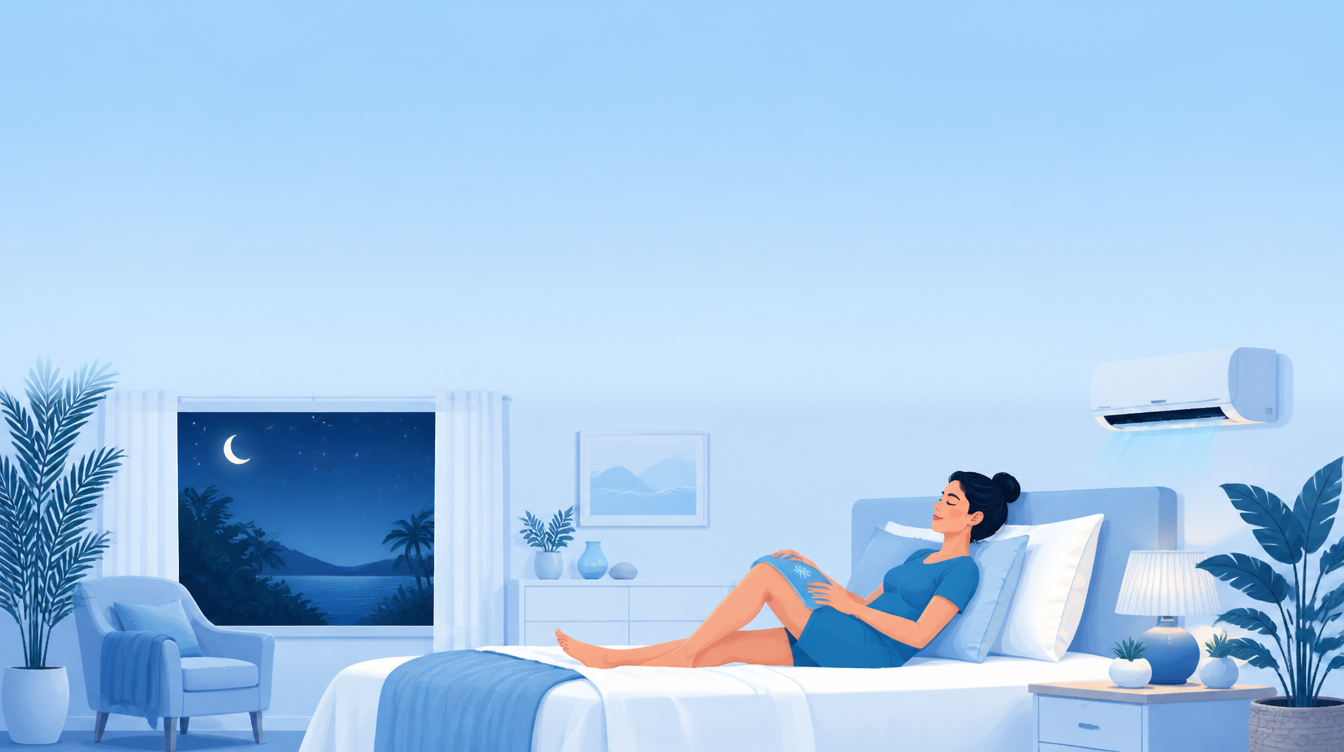
Keeping your bedroom around 24-26°C (75-79°F) with humidity near 50% supports both better sleep and lower joint pain. When your body is too hot or too humid, it struggles to reach deep sleep, and repeated shallow sleep feeds right back into the pain sensitivity described above.
Running an air conditioner or fan at full blast all night can dry the air out too much, irritating your airways and sometimes making muscles and joints feel stiffer. A timer that gradually adjusts the temperature works better than leaving it on high all night.
A lukewarm shower one to two hours before bed helps your core body temperature drop naturally, making it easier to fall asleep. It also helps to avoid caffeinated drinks like coffee, green tea, or cola in the late afternoon and evening.
Don’t rely on over-the-counter pain relievers long-term just to get through tropical nights. Extended use without medical guidance can cause stomach irritation or put stress on your kidneys. Always check with a doctor or pharmacist first.
For more detailed tips on joint stretches and heat therapy, see our (Internal link: to be replaced once a related article is published) Disease Encyclopedia category.
Source: Asan Medical Center Newsroom, “Staying Cool at Night: How to Sleep Well During Tropical Nights.”
Frequently Asked Questions
1. Does napping reduce joint pain caused by tropical-night sleep loss?
A short nap can help make up for lost sleep and may reduce pain sensitivity, according to research. However, avoid long naps after 3 p.m. or naps longer than 30 minutes, since they can interfere with nighttime sleep.
2. Is it okay to run the air conditioner all night?
It’s better to set a timer for two to three hours or use dehumidifier mode rather than running it at full blast all night. Air that’s too cold and dry can strain both your airways and your joints.
3. How many hours before bed should I avoid caffeine?
This varies by person, but it’s generally recommended to avoid coffee, green tea, and cola at least six to eight hours before bedtime.
4. Should I see a doctor if joint pain lasts more than two weeks?
Yes. If pain persists for more than two weeks or comes with swelling or warmth, see an orthopedic or rheumatology specialist rather than managing it yourself. In Korea, specialist visits like these are covered by National Health Insurance (Korea’s mandatory public health insurance system that subsidizes most medical costs), so cost shouldn’t keep you from getting checked.
5. Does repeated sleep deprivation raise the risk of arthritis?
It’s hard to call sleep loss a direct cause, but chronic sleep deprivation is reported to increase inflammation and pain sensitivity, which can worsen symptoms in people who already have joint conditions. Talk to a specialist for an accurate diagnosis.
References
(NIH), “Total Sleep Deprivation Increases Pain Sensitivity, Impairs Conditioned Pain Modulation and Facilitates Temporal Summation of Pain in Healthy Participants,” Link
(NIH), “The Bidirectional Relationship between Sleep and Immunity against Infections,” Link
(NIH), “Napping Reverses Increased Pain Sensitivity Due to Sleep Restriction,” Link
(Arthritis Foundation), “Arthritis Pain at Night: Tips to Position Yourself for Pain-Free Sleep,” Link
(Sisa Journal, Korea), “Tropical Nights Make Sleepless Joints Hurt More” (열대야로 잠 설치면 관절도 더 아프다), Link
(Asan Medical Center Newsroom, Korea), “Staying Cool at Night: How to Sleep Well During Tropical Nights” (한밤중에도 찜통더위…열대야 속 꿀잠 자는 법), Link
This article is for general informational purposes only and is not a substitute for professional medical advice, diagnosis, or treatment. Please consult a qualified healthcare provider if you have health concerns.
Leave a Reply